We had this Kyushu itinerary in the works for what felt like FOREVER!
I had never been to Kyushu before but my husband had 8 years ago, so we planned this Kyushu road trip itinerary based on his knowledge from his first trip and lots (and lots) and research on how we were going to maximise our time in Kyushu for 2 weeks.
Of course 2 weeks in Kyushu was never going to be enough to see it all, but I think we managed to pack in a lot of the main sights, some hidden gems and the best places to visit in Kyushu for our trip.
I will say, this is a pretty packed itinerary, if you have longer available then you can definitely spread it out over 3 weeks or more, or spend longer exploring each area further. We had just come from a week in Ishigaki and a week in South Korea so we were on a time crunch!
That said, I hope this Kyushu itinerary is useful in helping you plan your own Kyushu travels. I've given general overviews of what we did on each day/section of the trip but I also have in-depth itineraries for a lot of these places including Fukuoka, Beppu, Nagasaki and beautiful places in Kyushu so I’ll link those in the relevant sections for you to do more of a deep dive.
If you have any questions, just drop me a message!
Disclosure: This post may contain affiliate links, which means I may receive a commission if you click a link and purchase something. While clicking these links won't cost you anything, they will help me to keep this site up and running! Check out the full disclosure policy for more details. Thank you so much!
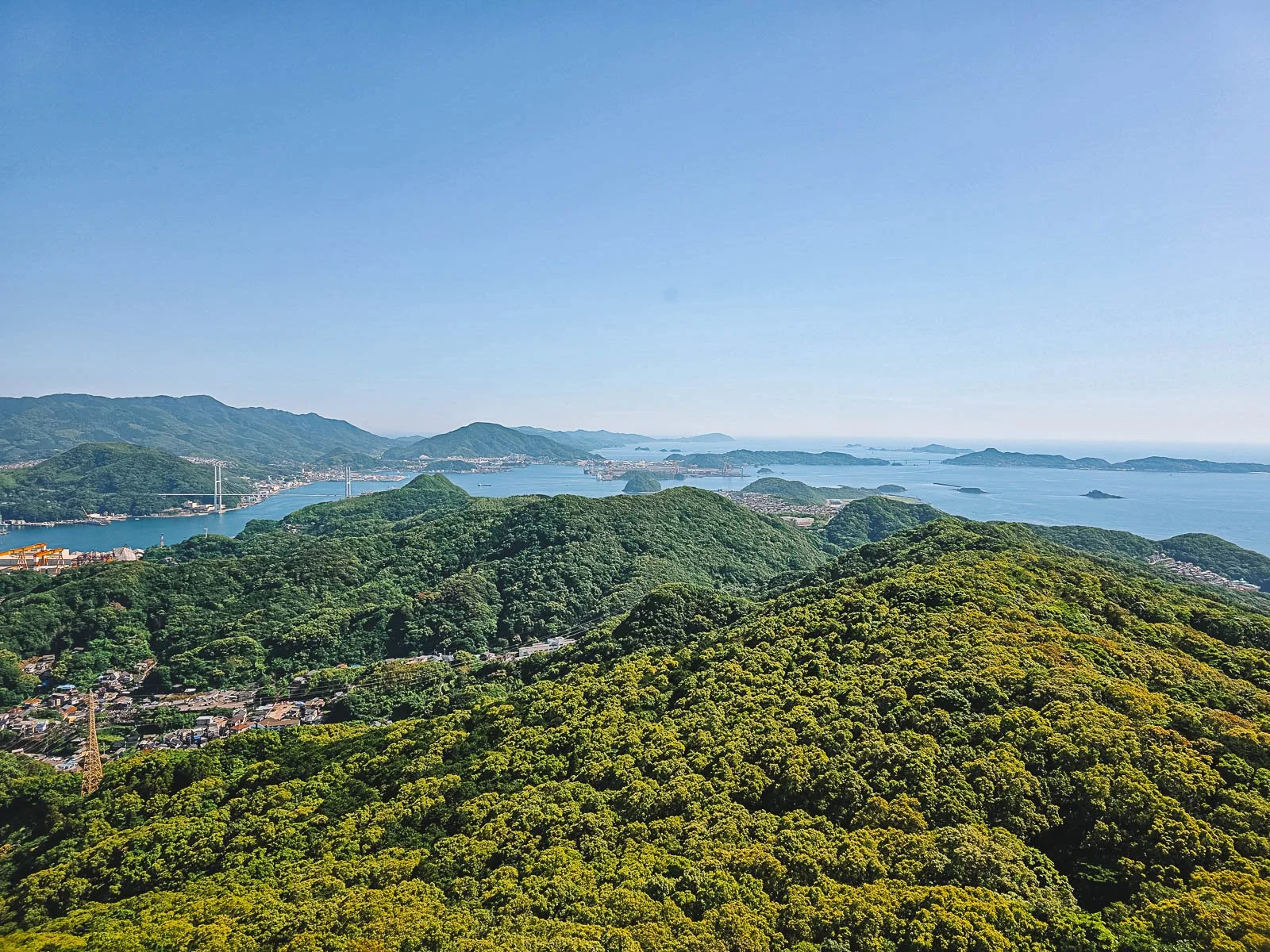
Nagasaki in Kyushu
How to get around Kyushu
For this Kyushu itinerary we hired a car. To get to some of the places we stopped, such as around Takachiho Gorge or some of the more remote shrines in this guide, there was no other way to get there other than having a car.
We have both driven in Japan before and driving in Kyushu was easy.
However you do need an International Driving Permit (IDP) for driving in Japan as well as your full license from your home country. They will not rent to you without an IDP.
We did a price comparison of hire cars via Klook as this seemed to be the only platform that displayed local car rental agencies which are significantly cheaper than the global brands like Enterprise, Avis, Hertz or Sixt.
Kyushu itinerary: 14 days self drive route map
Just to give you an idea if you’re a visual person, here’s a screenshot of what our route looked like:
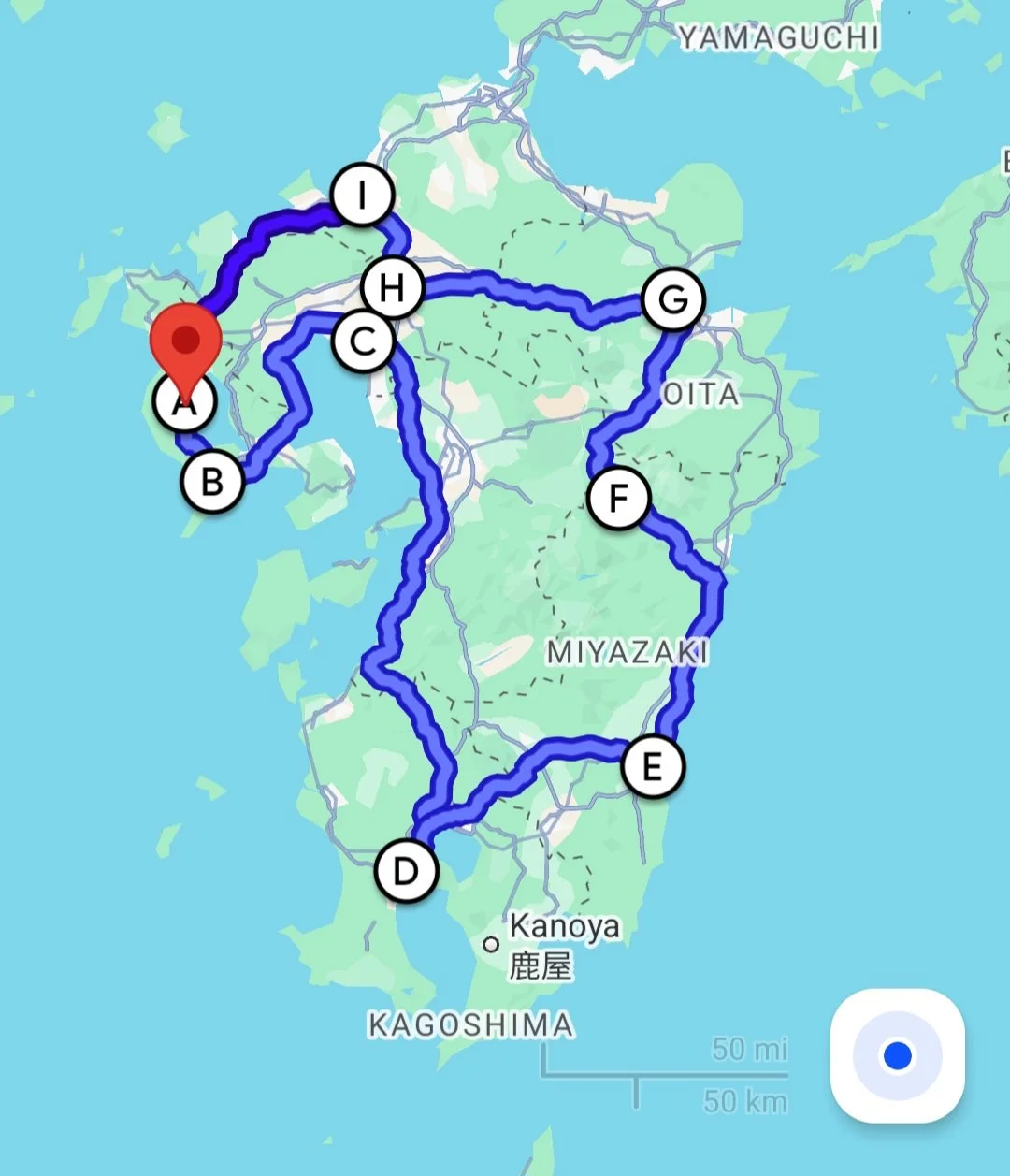
Map of our Kyushu route
A 2 week Kyushu road trip itinerary
Day 1-3: Fukuoka
Where we stayed: Best Western Plus Fukuoka Tenjin-minami
We spent five days in Fukuoka in total, splitting them between the start and end of our Kyushu road trip, and I absolutely rate this city. It is much quieter and less touristy than the big hotspots like Kyoto or Tokyo, but there is so much to do.
Don’t miss Tochoji Temple and Kushida Shrine as well as the Hakata Old Town area.
The Daimyo area is also a must-see part of the city with loads of vintage and secondhand stores, plus Fukuoka Craft - a brewery with Mexican food that was totally unexpected!
The food scene in Fukuoka is HUGE. Obviously Hakata Ramen is from Fukuoka so ramen is a must have. There’s loads of ramen restaurants and you can visit the Ramen Stadium in Canal City which has dozens of ramen restaurants serving different types of ramen from all over the country.
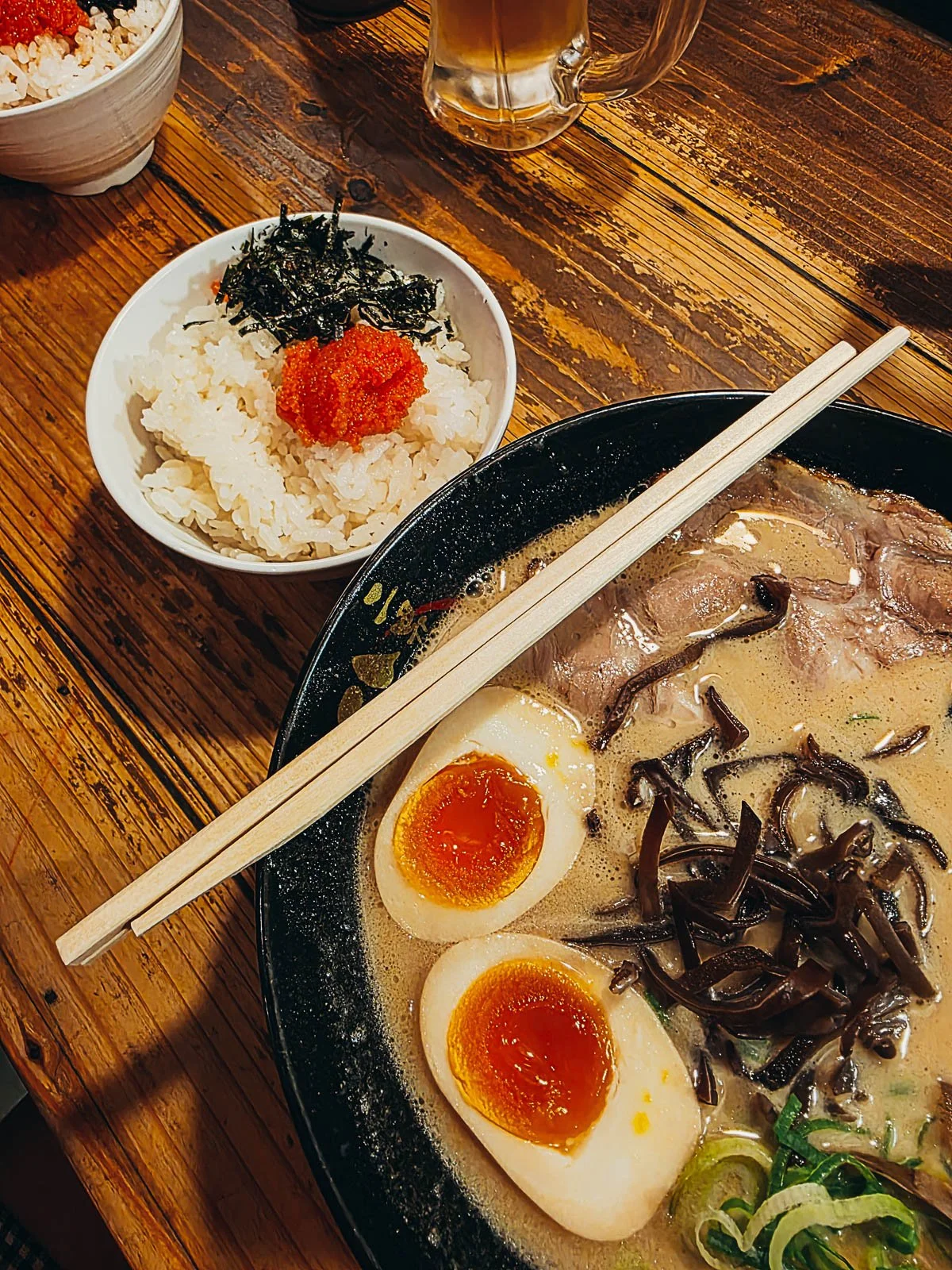
Hakata Ramen
Yatai food stores are also famous in Fukuoka. These are mobile food stands that pop up at night - such a fun, must do experience.
If you have time, the teamLab Forest is right next to the baseball stadium and is a great way to spend an afternoon before you begin the driving portion of your trip.
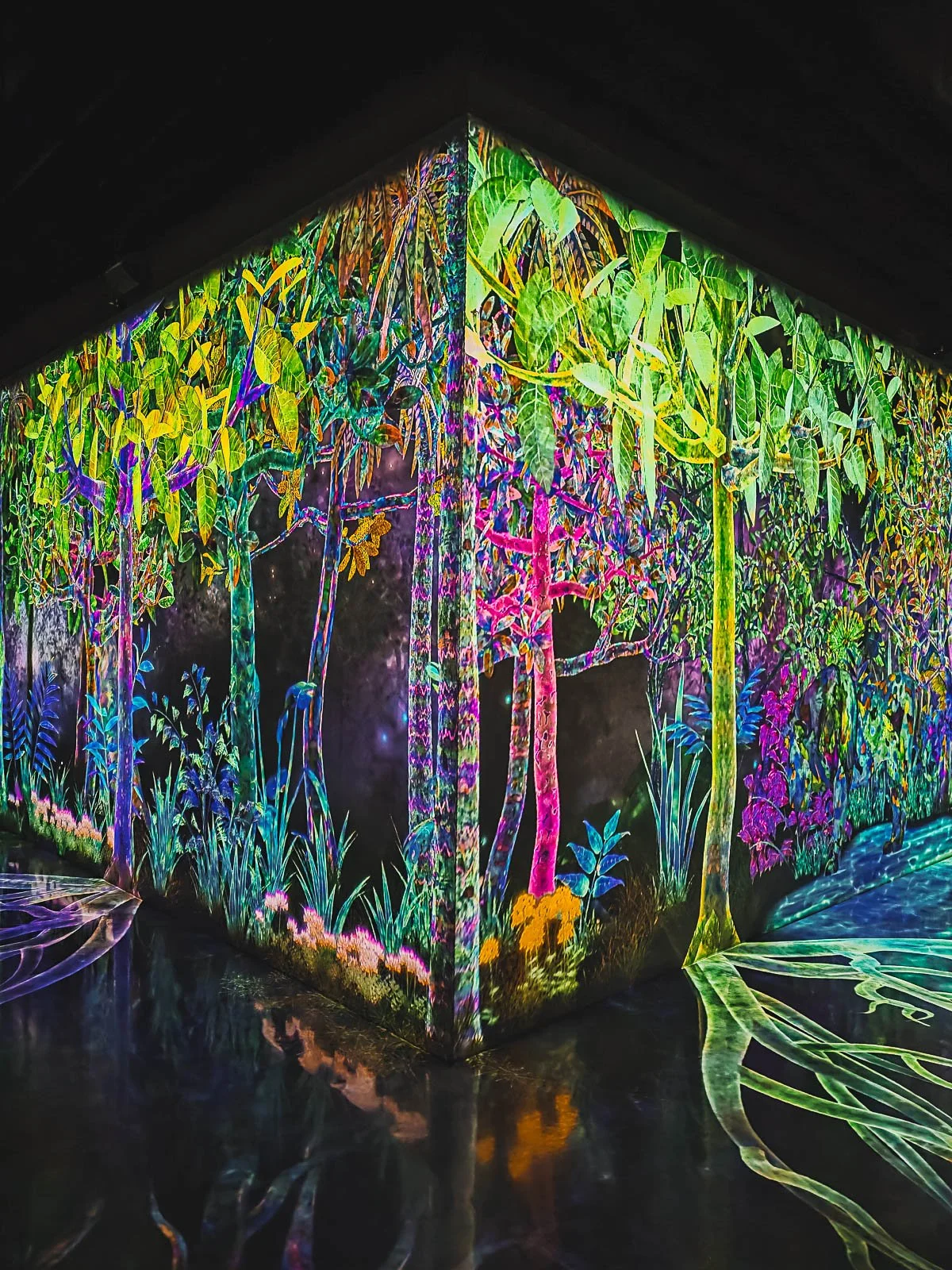
Fukuoka Teamlab
I highly recommend visiting Nanzoin Temple. It is just a short train ride from Hakata Station on the Fukuhokuyataka Line to Kidonanzoin-Mae Station. It features a massive 41m long reclining Buddha, which is said to be the largest bronze statue in the world.
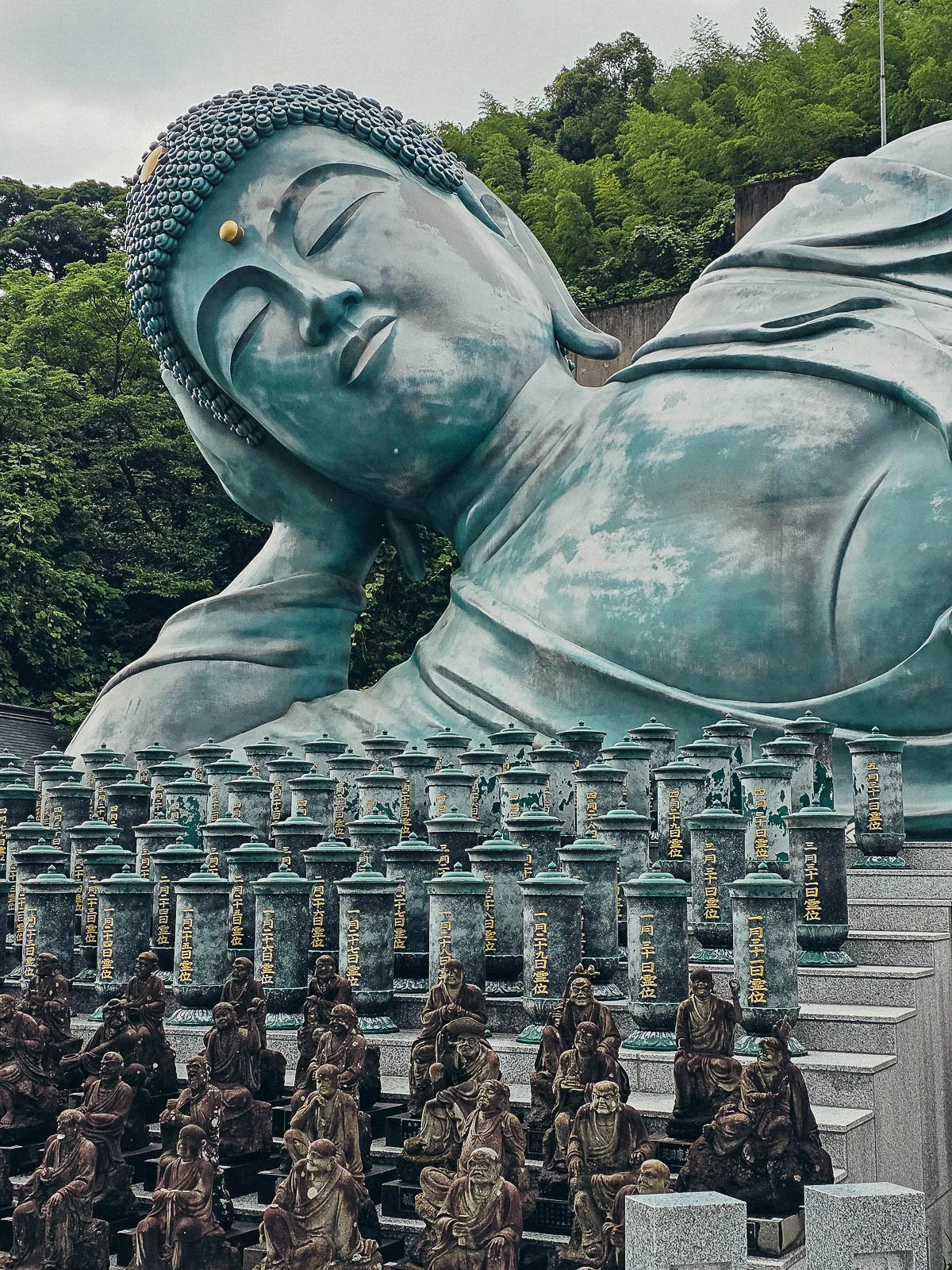
Nanzoin Temple
Entering the temple costs 300 yen, and there are strict dress codes: women must have knees and shoulders covered but the complex is truly stunning and there’s so much to explore through eerily quiet forest paths and mysterious caves.
Day 4: drive to Nagasaki
We had kind of left this day open for what to do depending on the weather. I really wanted to go to Yanagawa or Itoshima Peninsula on the coast but unfortunately the weather was not on our side and we had a lot of rain.
Instead we drove the longer route, along the western side of Kyushu to reach Nagasaki, stopping on the way down at Nagasaki Bio Park to see the capybaras (my favourite animal).
Another stop you can do as an alternative to the Itoshima Peninsula is the Tōzan Shrine. This is a porcelain shrine which we didn’t have time to visit on this occasion but it’s definitely on my list!
It was a longer route along the west side of Kyushu, but the drive was stunning, especially along the coastline of Omura Bay and we knew we would drive back on the shorter route along Nagasaki Expressway to get to our next stop after Nagasaki.
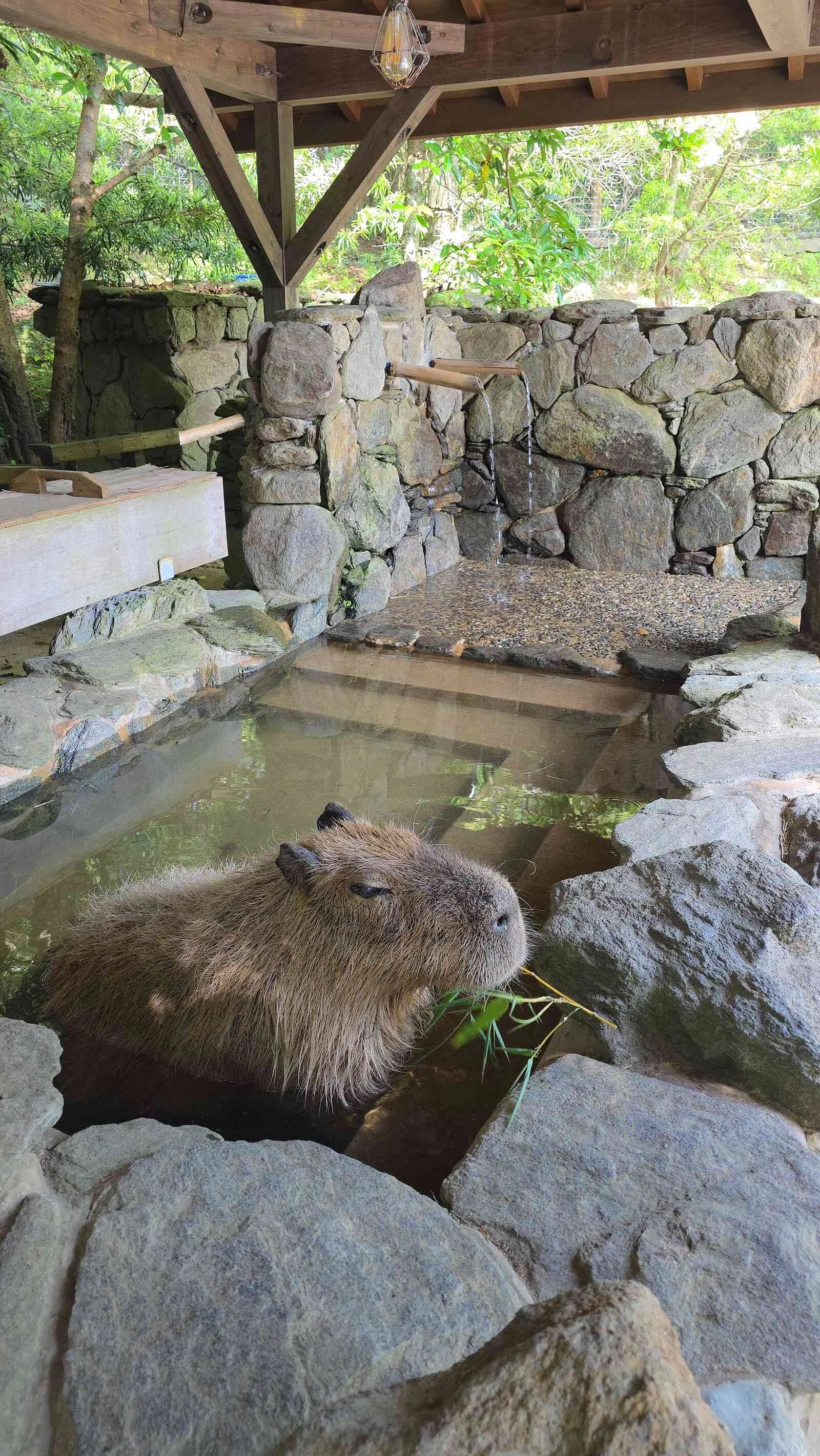
Capybara at the Nagasaki Biopark
Day 5-6: Nagasaki
Where we stayed: Hotel Forza Nagasaki
Read my in-depth Nagasaki itinerary here.
We had two days and three nights here on our Kyushu road trip itinerary, and I honestly wish we had longer.
Nagasaki is globally known for the atomic bomb that was dropped on it by the USA in 1945, and I highly recommend you visit the Nagasaki Atomic Bomb Museum. It shares survivor testimonies and the human scale of the destruction in a way that is heavy but incredibly important.
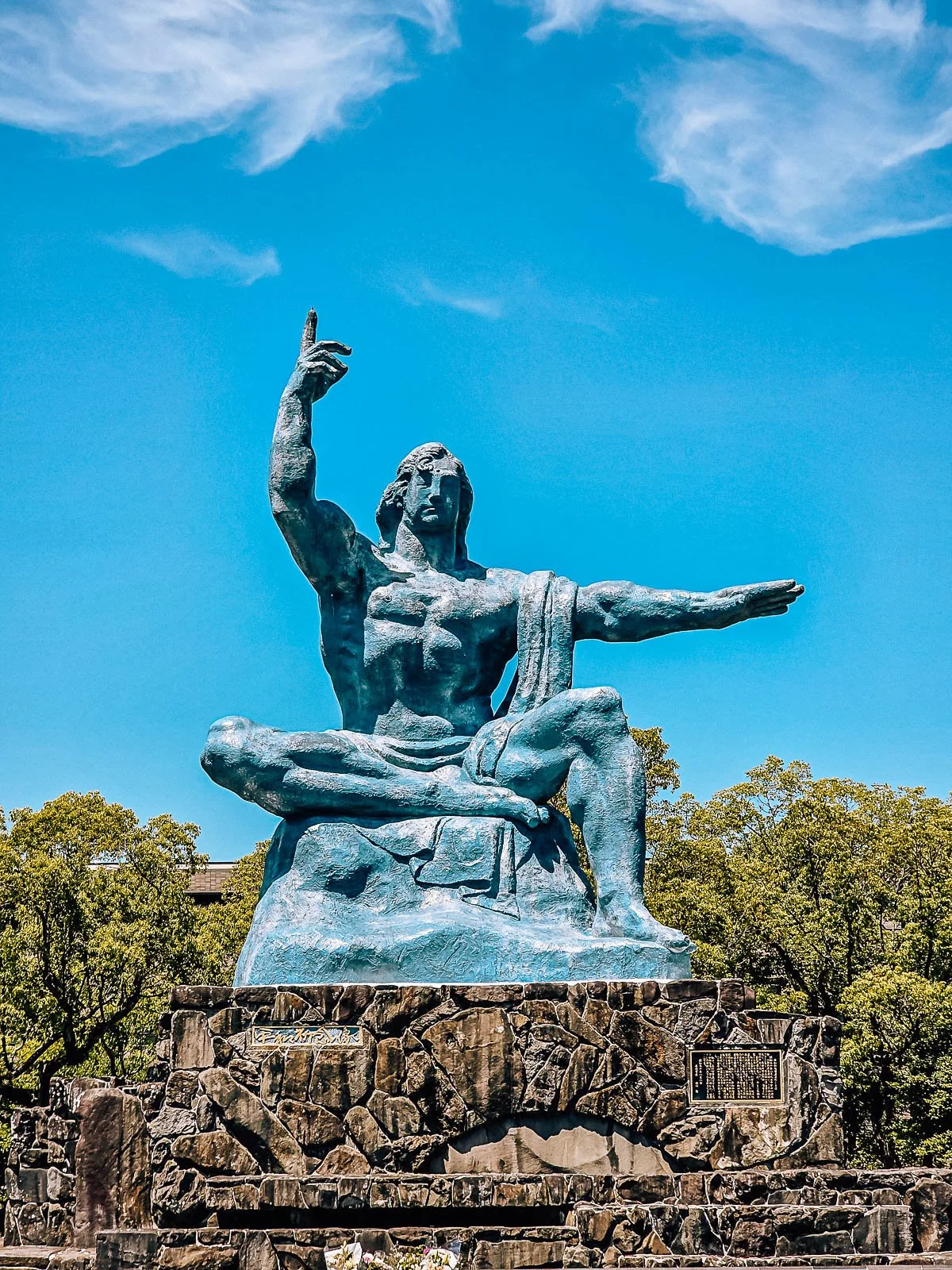
Nagasaki Peace Park
Something I found fascinating is that stats after the A-bomb said nothing would grow here for 75 years, Nagasaki is now one of the greenest, lushest cities I’ve visited in Japan and we happened to be visiting in 2025 - 75 years after the atomic bomb was dropped.
On the same day you visit the Atomic Bomb Museum I also recommend visiting the Atomic Bomb Hypocenter and the Peace Park, as well as the Sannon Shrine one-legged torii gate, which was the only part left standing after the blast.
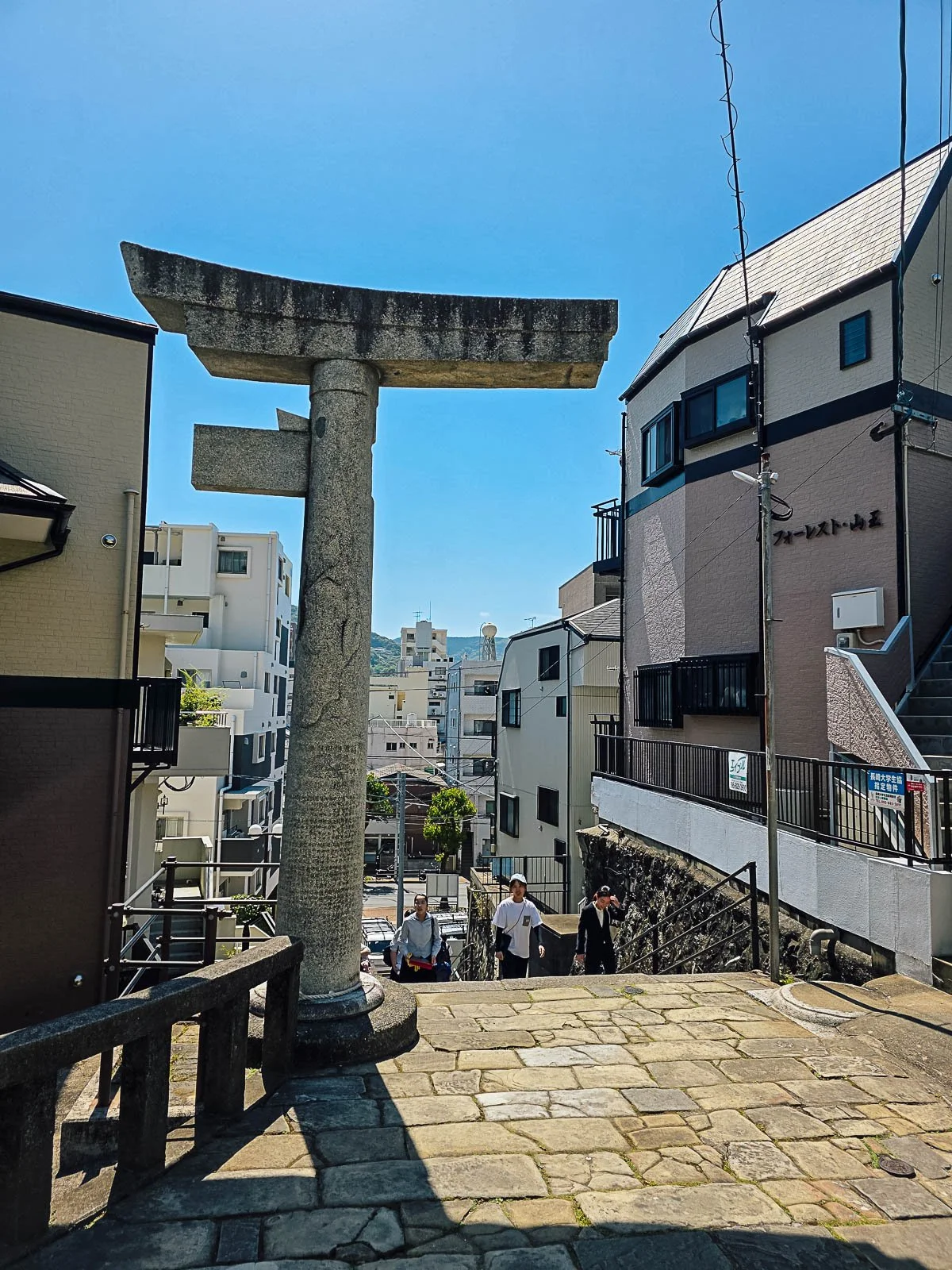
One Legged Torii Gate
On our second day we took the Nagasaki ropeway to see the amazing view of Nagasaki from Mt. Inasa overlook which really gives you a perspective of the city, its position on the coast and how much incredible greenery there is here.
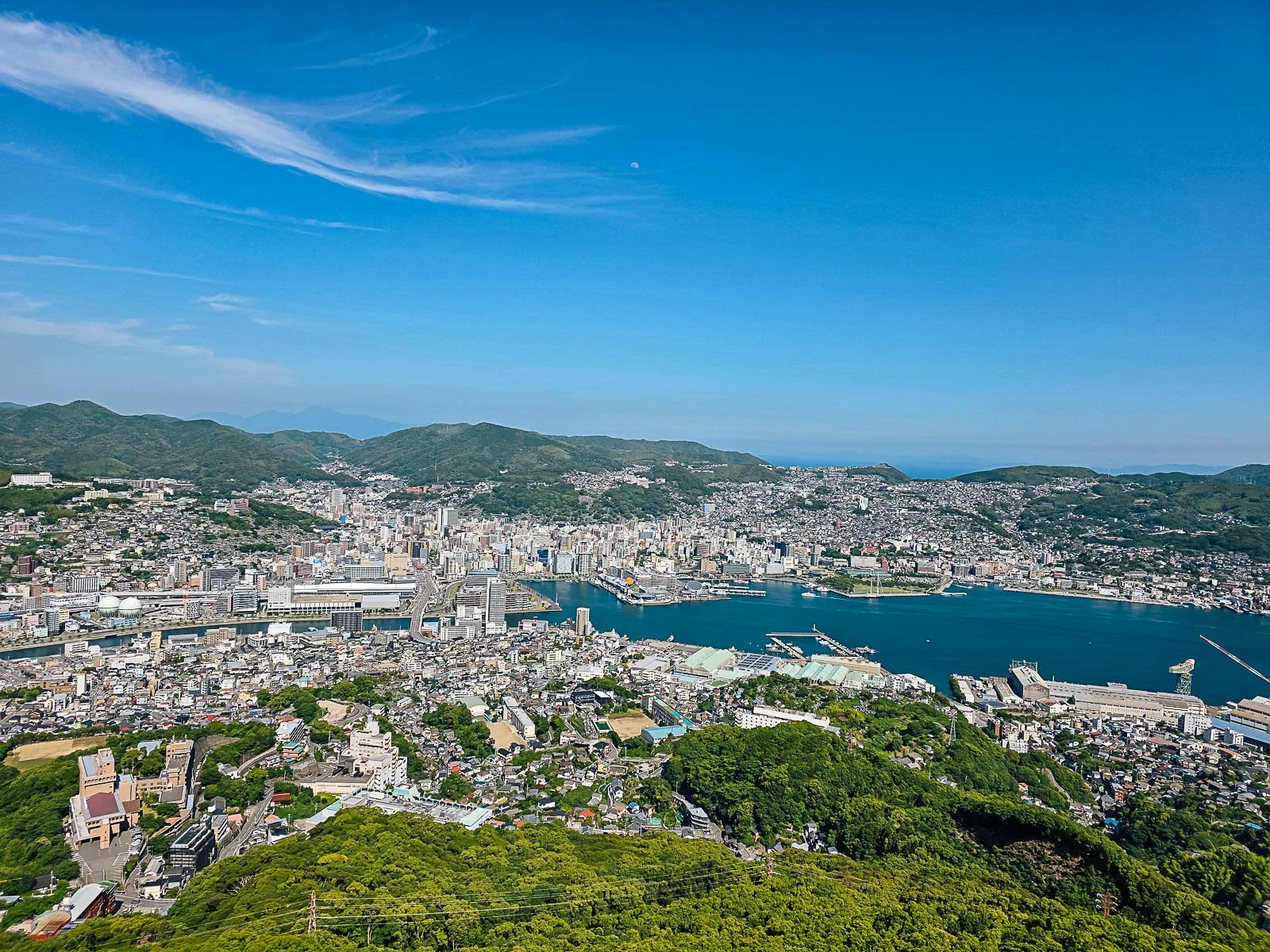
Mount Inasa
In the afternoon, spend time exploring Glover Garden, walking through Chinatown which is the oldest Chinatown in Japan, or eating the famous tomato-based Nagasaki ramen at Ramen Hiiragi.
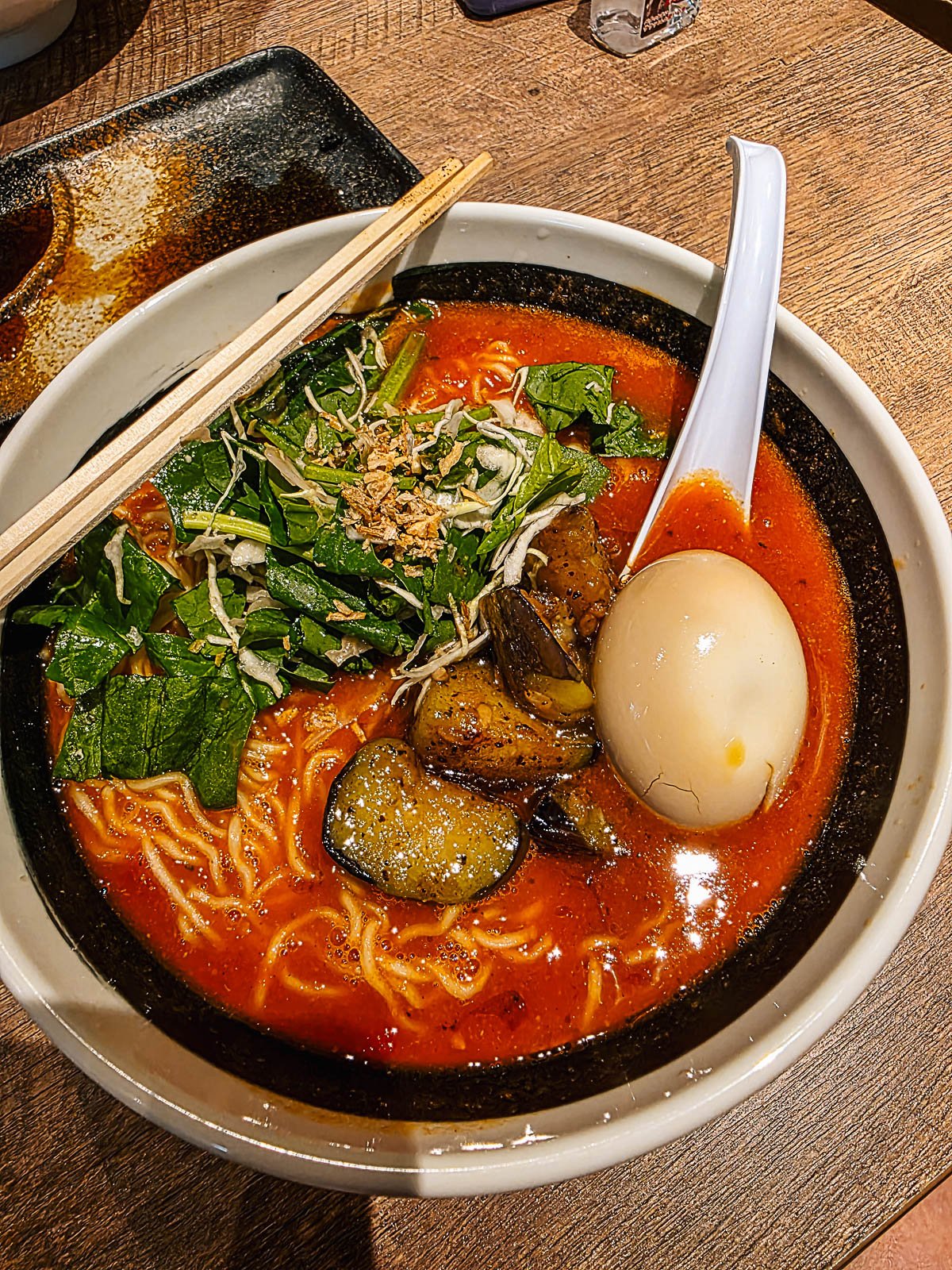
Hiiragi Ramen
Day 7: drive to Kagoshima via Yanagawa
This was a fairly long driving day which is why we broke it up with a stop in Yanagawa - the “Venice of Japan”.
This area is most popular for punting on the canals, which include the moat of an old samurai castle. It is especially beautiful in spring when the cherry blossoms hang over the water. It’s also famous for the boat punters who jump off the boat onto the bridge then jump back on to the boat on the other side.
Unfortunately due to the continued bad weather in Kyushu, the boats weren’t running so we weren’t able to ride in one - boo! But it is a pretty town to wander around before getting back on the road.
If you are there in mid-to-late April, you can also see the Wisteria Tunnel of Nakayama.
Head to the Suigo Yanagawa Kanko area to find the wooden punt rentals and explore the old town before continuing your drive toward Kumamoto.
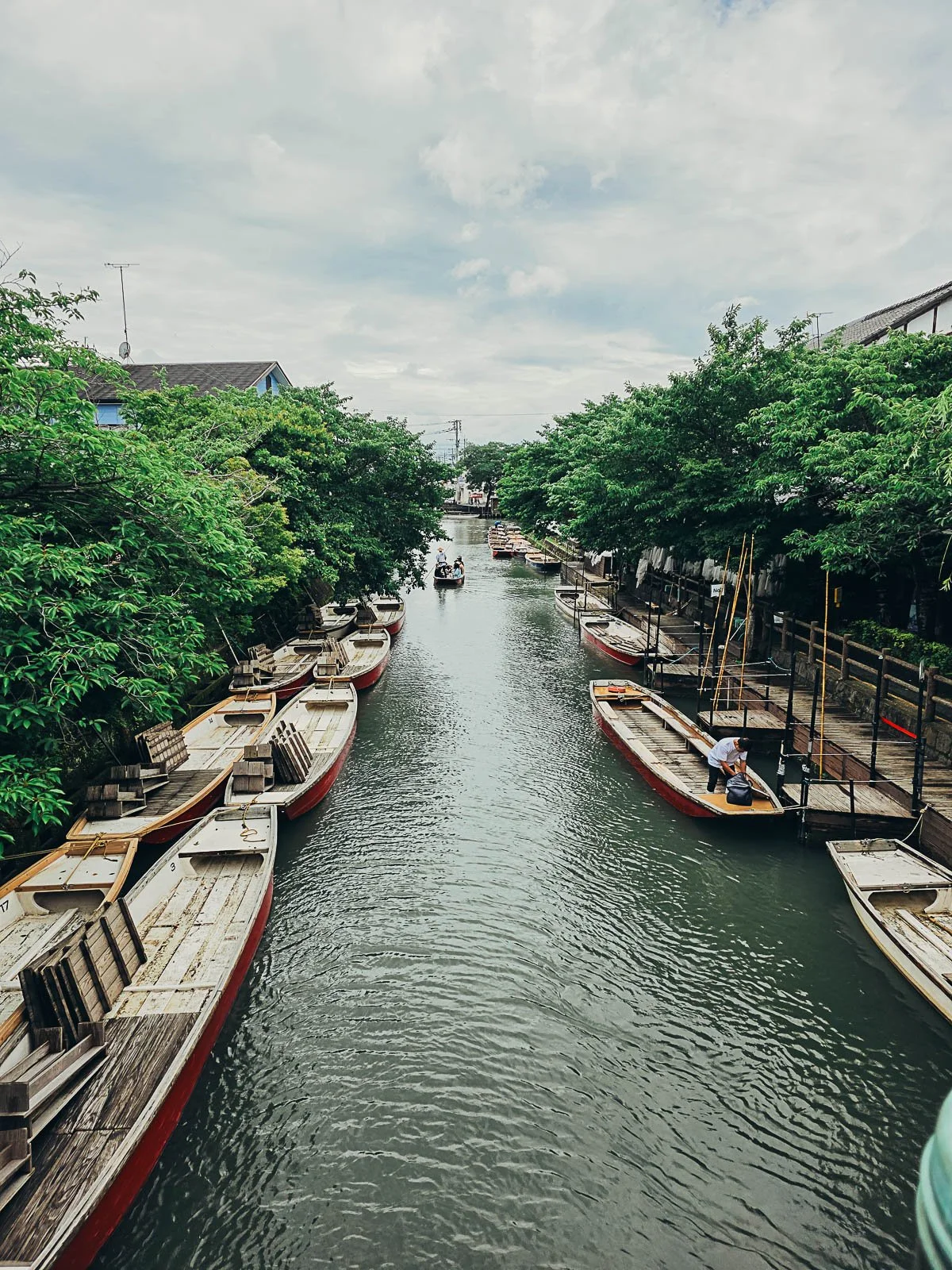
Yanagawa
Day 8-9: Kagoshima
Where we stayed: Henn na Hotel Premier Kagoshima Tenmonkan
The volcanic landscape of Kagoshima is another underrated city in Japan and our main reason for visiting was to see Sakurajima, an active volcano across the bay that erupts almost every day. You can see smoke rising from the crater even from the city side of the bay.
On your first day in Kagoshima, take the 20-minute ferry over to the island, it costs 250 yen one way, and spend the whole day exploring.
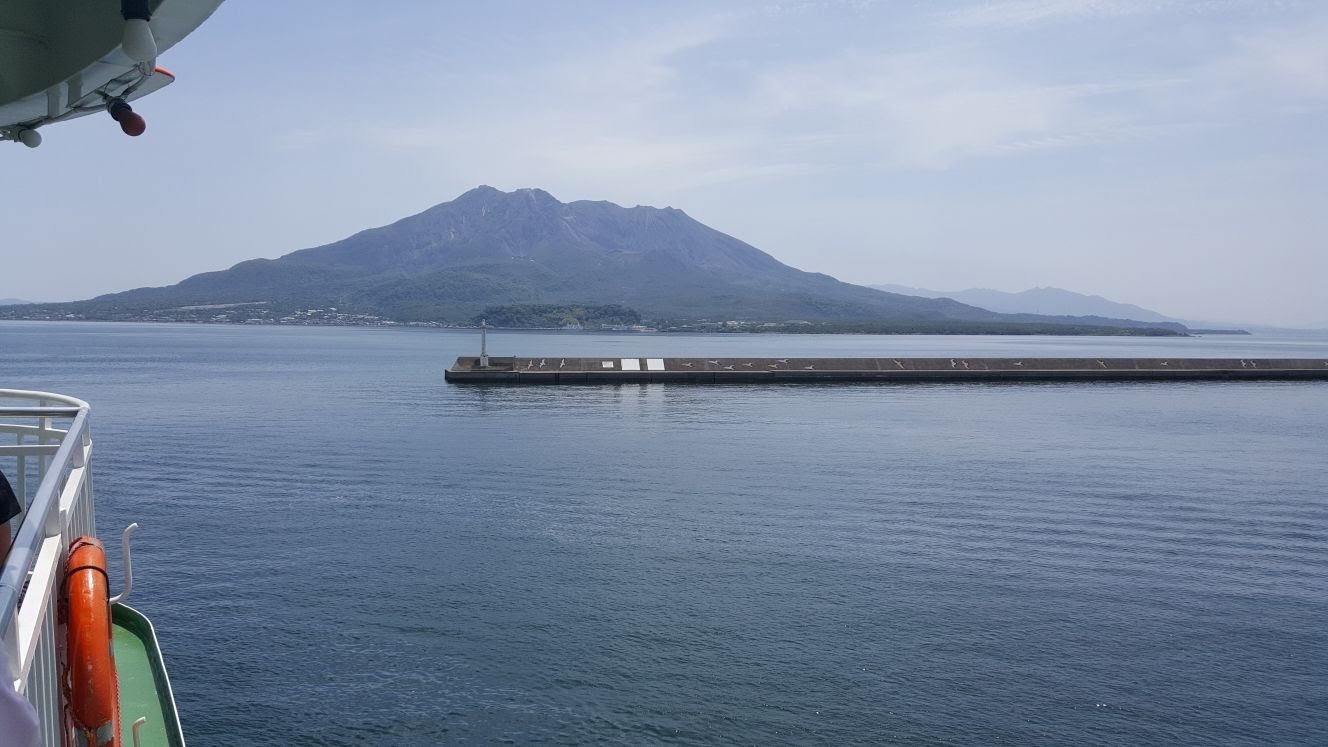
Sakurajima
I recommend taking the sightseeing bus from the ferry port to the Yunohira Observation Deck for panoramic views of the lava fields. If the weather is clear, you can see the smoke rising from the crater.
There’s plenty of hikes on the island too which we unfortunately couldn’t do due to the weather but it’s the best ways to spend the day on the island.
Afterward, visit the Sakurajima Visitor Center and enjoy the free hot spring foot bath located just across the road, which is a beautiful spot to soak in the views.
On your second day, explore Kagoshima city itself.
Head up to Shiroyama Park Observation Deck for more city views and views of the volcano - it’s best on a clear day.
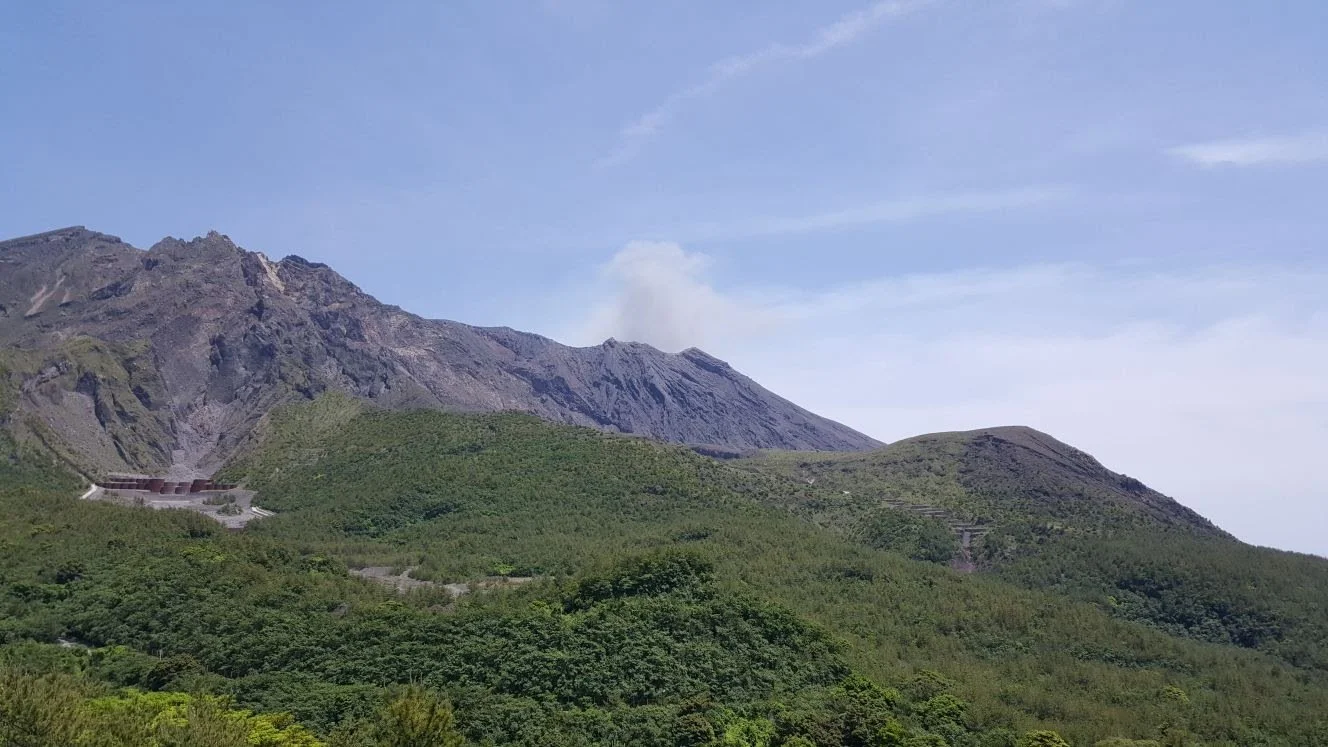
Sakurajima Kagoshima
In the afternoon we drove down the peninsula to Saraku Sand Bath Hall. Here you can be buried in the hot volcanic black sand on the beach for 20 minutes which has detoxifying properties. Then you go inside to enjoy the onsen baths for a soak afterwards.
We were staying in the Tenmlonkan area of Kagoshima which was great for izakayas, bars and restaurants. We visited 薩摩しむじゃ for ramen, location here on Google maps. It’s the Kagoshima-style of ramen which is light but very filling. Then had drinks at 46 Craft Kagoshima taproom.
Day 10: drive Miyazaki coast
Where we stayed: ANA Holiday Inn Resort Miyazaki by IHG - Honestly this was a bit of an odd and tired resort on the coast, rooms where huge but stuck in the 80s and 90s. We picked it because our route changed so last minute and it was close to Aoshima Shrine but it's popular for surfing so that’s a bonus!
From Kagoshima we drove across to the east coast of Kyushu, first visiting Udo Shrine which is a unique shrine located in a cave along the coast with the waves crashing below, we were 2 of only a handful of people there. You can also try to toss clay wishing stones into a rope circle on the rocks below for good luck.
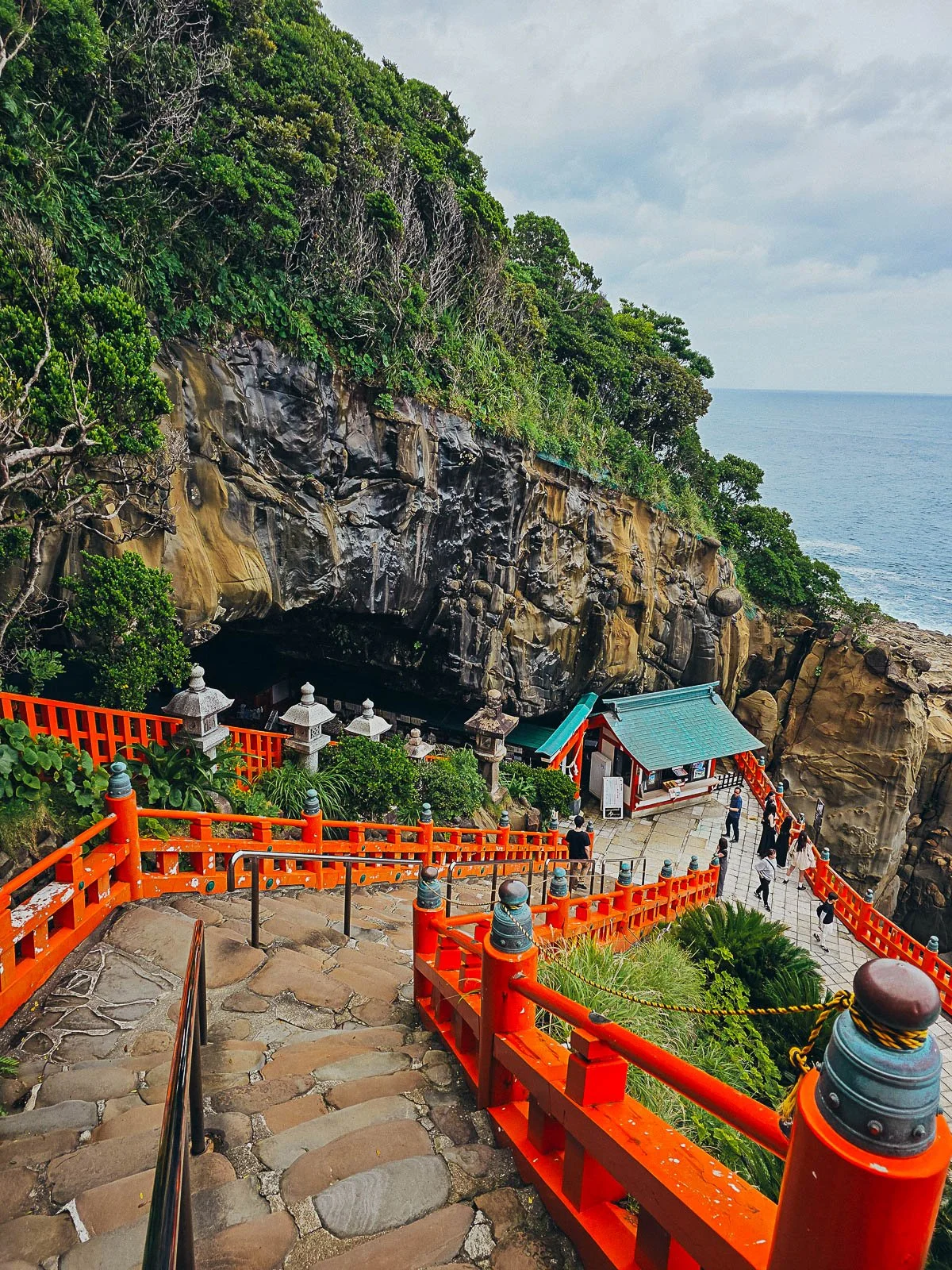
Udo Jingo Shrine
Then following the coastal road north, stopping to see the Moai statues at Sun Messe Nichinan which are the only licensed Moai Statues outside of Easter Island, gifted to Japan by Easter Island officials as a thank you for their assistance after an earthquake. It costs 1,000 yen to enter the park which is pretty steep and honestly, the park is kind of weird with not a lot else to do there… but it was cool to see the statues.
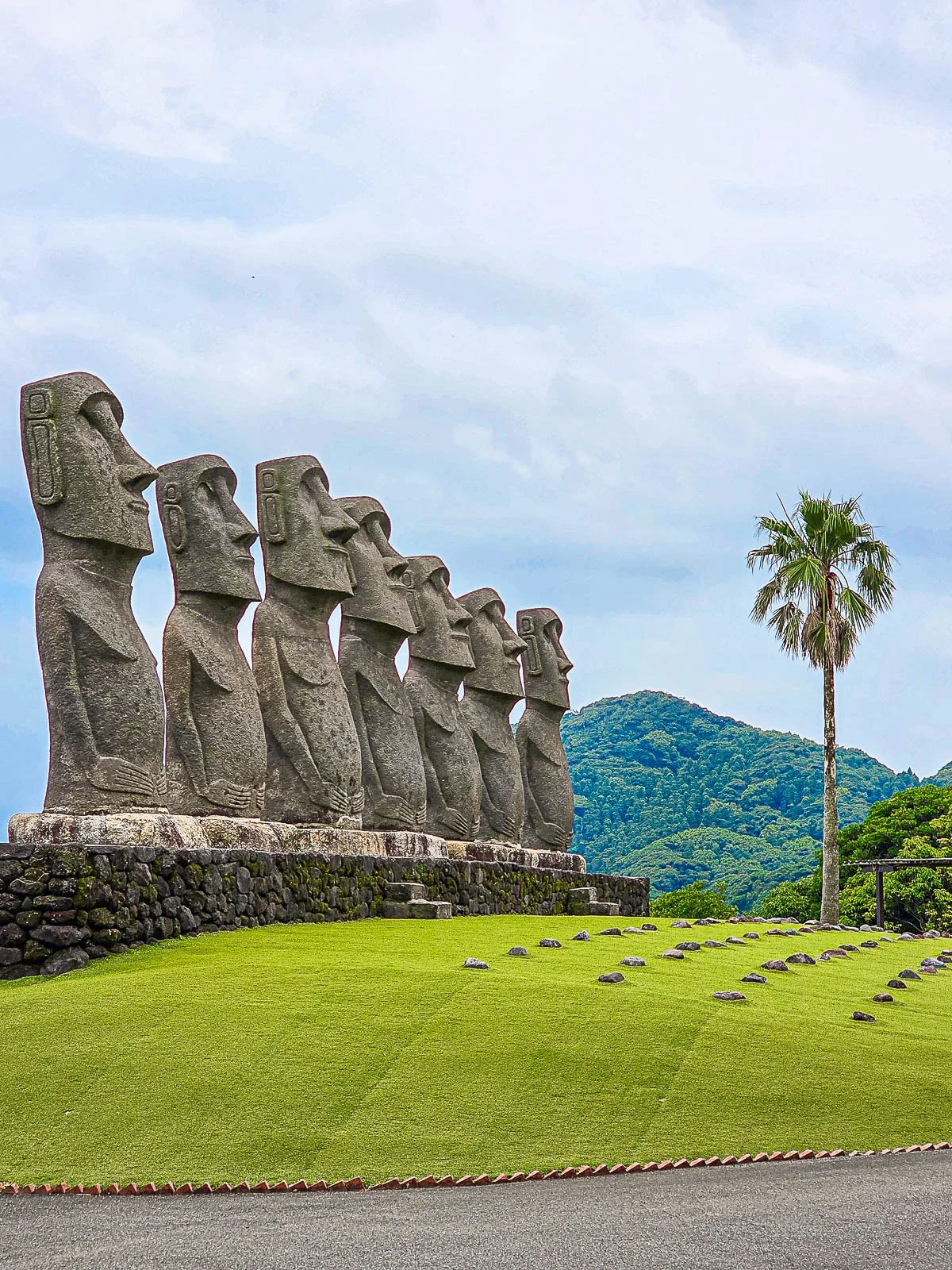
Sun Messe Nichinan
Continuing up the coast along the Nichinan Coast Road, our next stop was Aoshima Shrine, a shrine located on a tropical island just off the coast, surrounded by jungle. You can reach the island by foot, simply park at the nearby car park then walk across the raised bridge which takes you over the sandy beach and rocks, known as the Devil’s Washboard.
We stayed the night in Miyazaki before continuing our drive north.
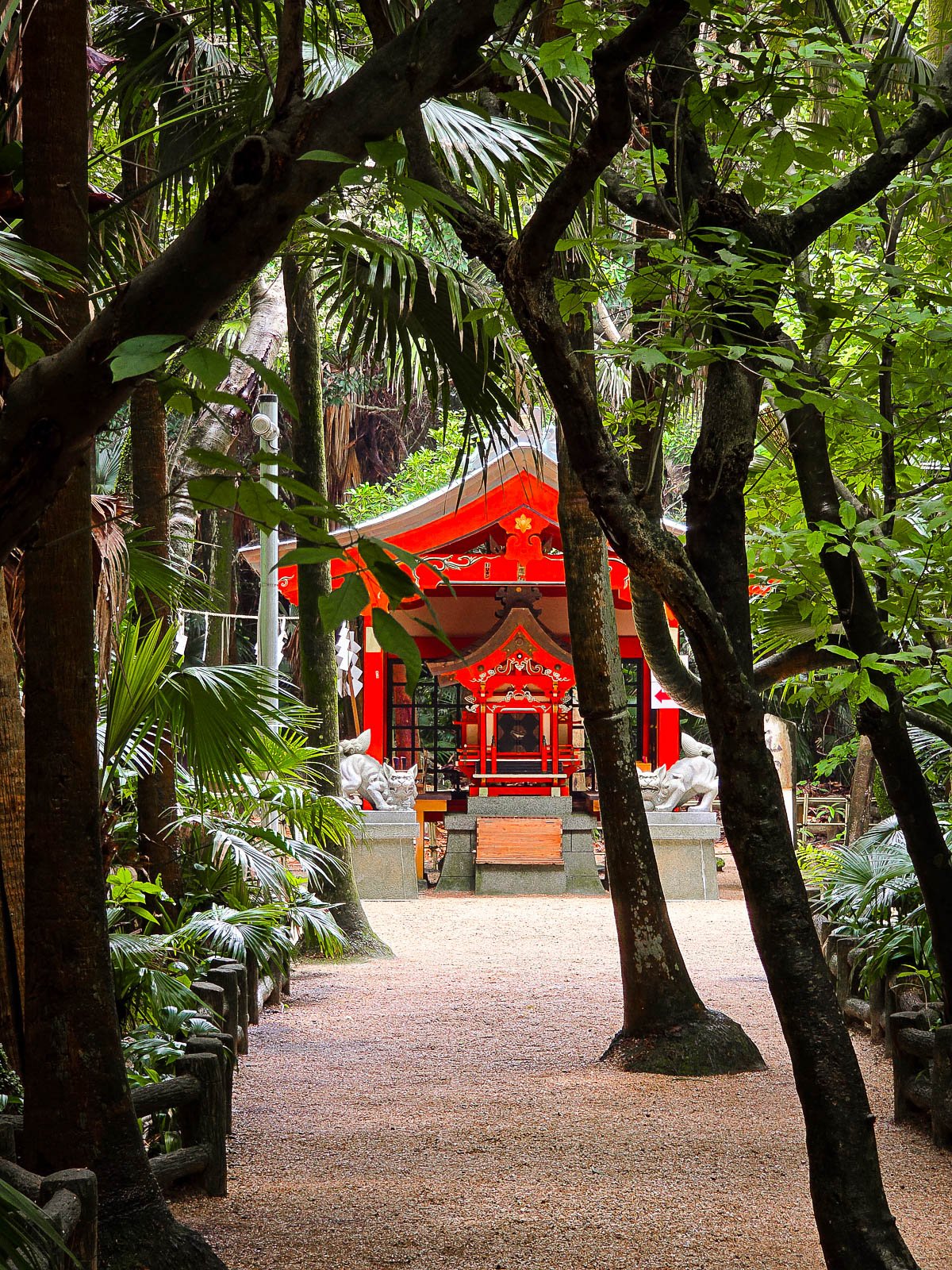
Aoshima Shrine
Day 11: Takachiho Gorge
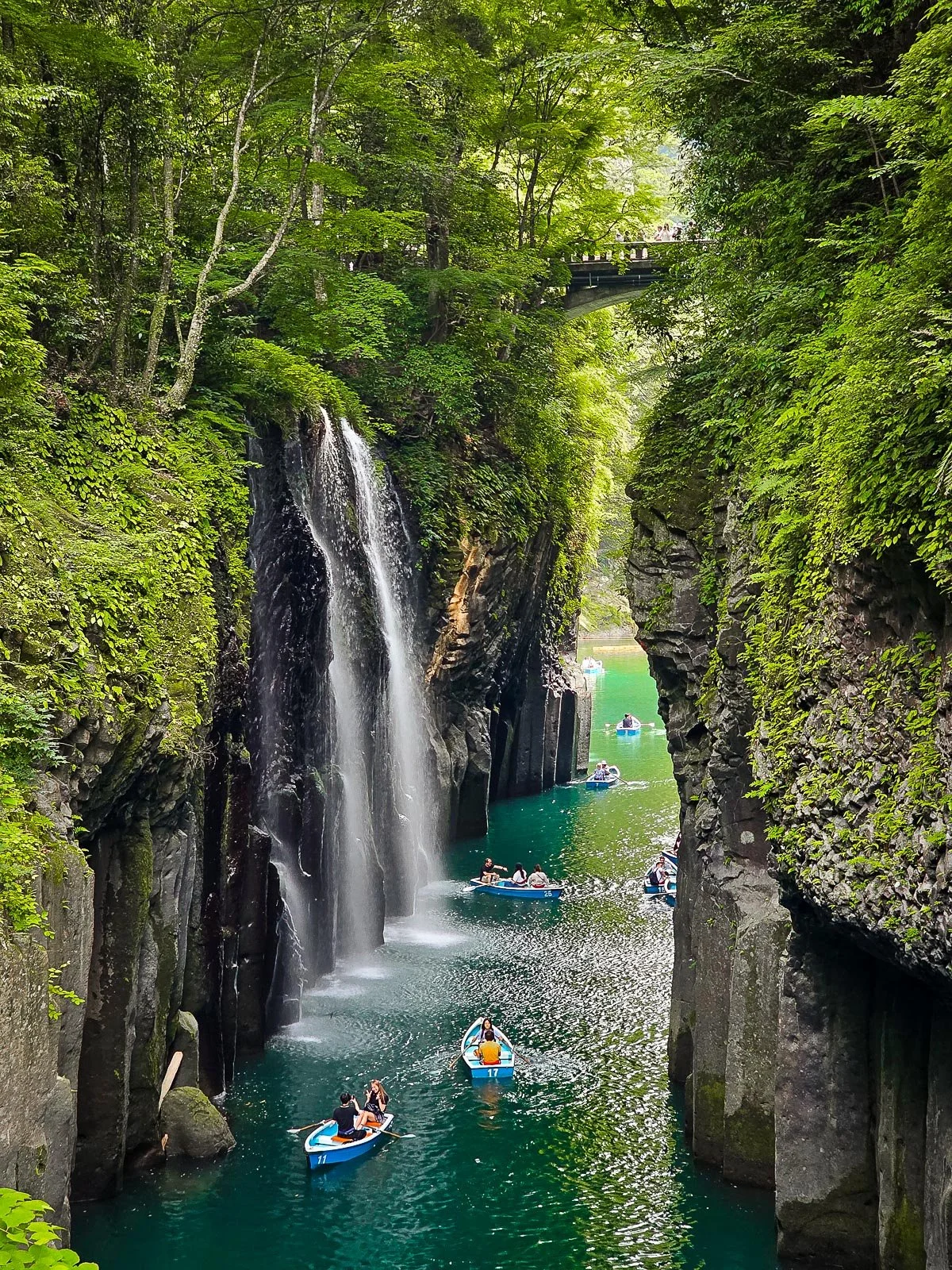
Takachiho Gorge
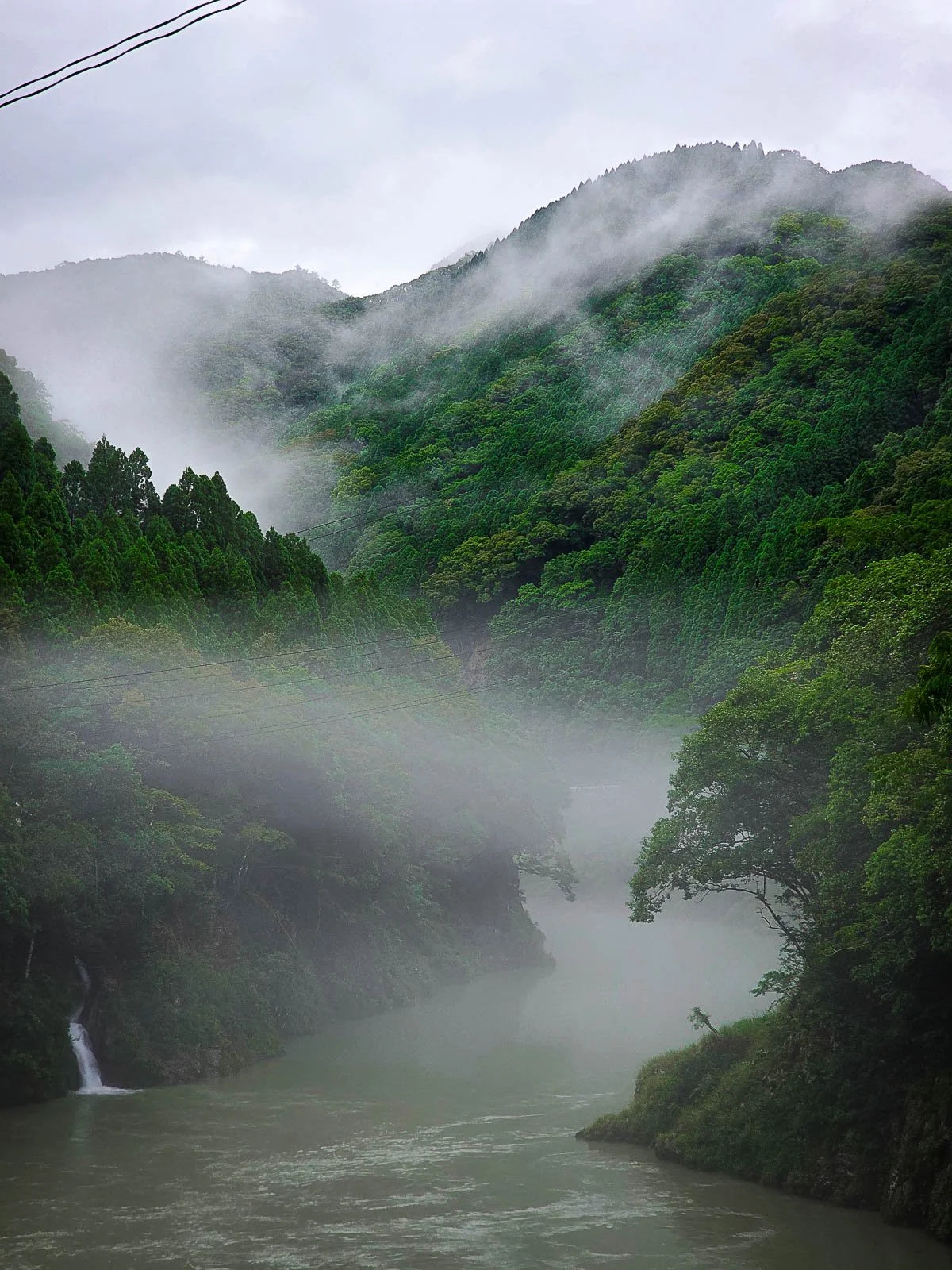
With the weather still not on our side, we turned inland to see the lush, green mountain landscape which was very atmospheric in the low cloud and mist thanks to all the rain we were having!
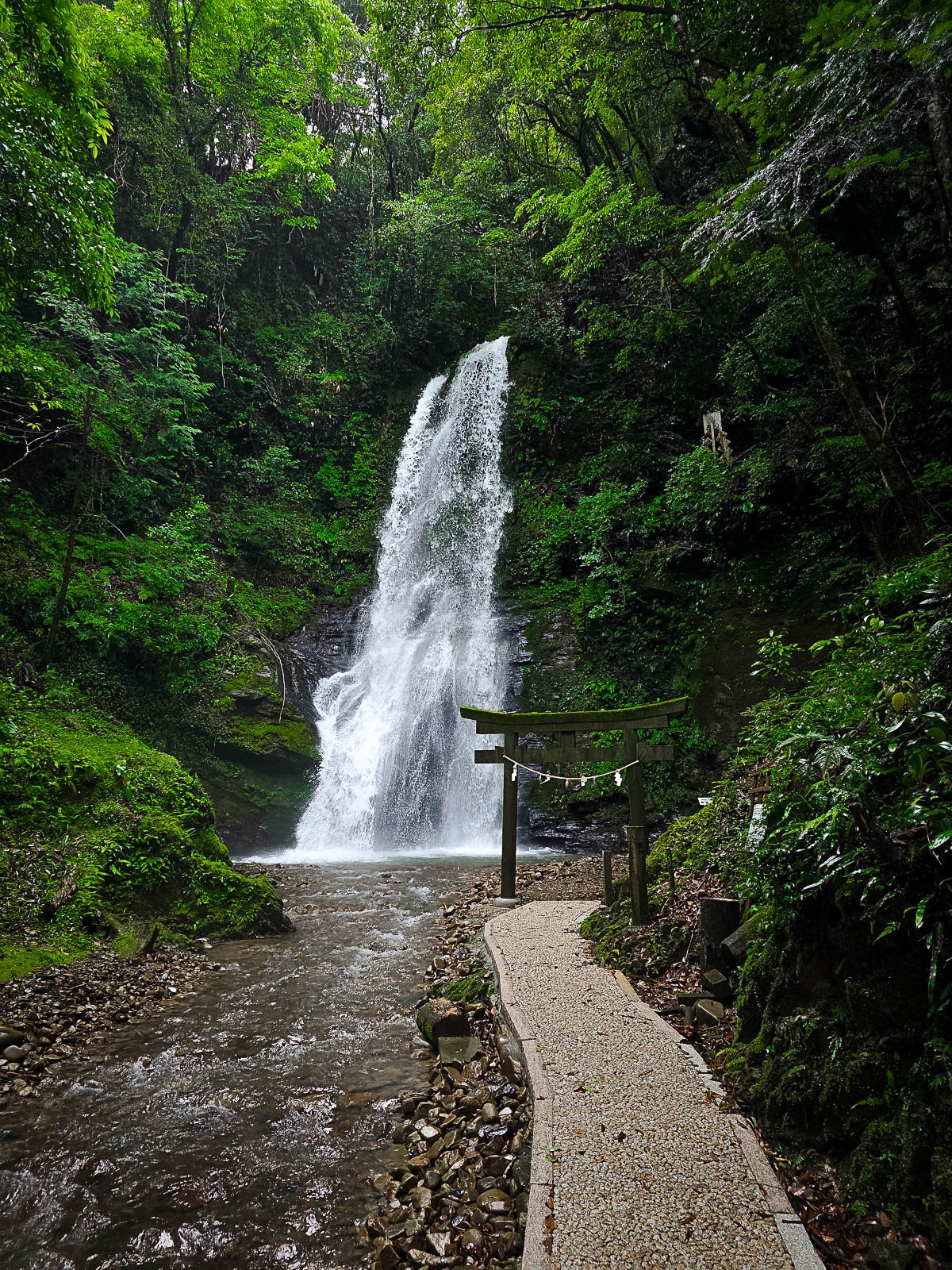
Our first stop was at Hayahirakitohiuri Shrine which I think was one of the top highlights of our entire trip. I will say that it’s a bit out of the way, so if you’re pressed for time, it might be better to skip. We just had such a memorable and magical experience here that I made it special for us.
To get there you drive through a river canyon which was dark green with low mist when we were there. There’s a small car park and you walk across a suspension bridge which takes you to the other side of the river. We were the only people there and it was so misty you could barely see the other side of the suspension bridge!
Along the riverbank and eventually you reach the shrine which is small and has a blue torii gate and a small shrine hall which was all unmanned and there’s an honesty box to pay for any of the shrine trinkets you might purchase.
Hayahirakitohiuri Shrine
River Canyon
Being the only ones there only made it more magical as you walk to the back of the shrine to see a single torii gate at the base of a crashing waterfall - it was just magic. It was eerie and serene and almost otherworldly and truly one of the most memorable experiences I’ve had in Japan.
I’d imagine if you’re in Kyushu and there hasn’t been a lot of rain then the waterfall might only be a trickle, so be prepared for that if you do visit! This is where the deluge of the last week was finally on our side!
After that, we continued our drive to Takachiho Gorge - probably one of the most famous places to visit in Kyushu. Despite its popularity, I still think it’s worth adding to your Kyushu itinerary.
Takachiho Gorge is formed of basalt columns with a vibrant turquoise blue river flowing through the canyon. You can rent a boat to row on the river but be warned - these are released two weeks ahead and sell out almost immediately, especially on weekends.
You can book a boat rental here. They cost between 4,100 and 5,100 yen for a 30 minute boat ride, depending on the season.

Takachiho Gorge
Parking is 500 yen if you park at the gorge, however this car park was already full when we visited so we parked further away which was free.
Read my full Takachiho Gorge guide here with tips on where to park for free, where to walk and best time to visit (clue: do not visit after heavy rain because the water is brown and the boats are cancelled)
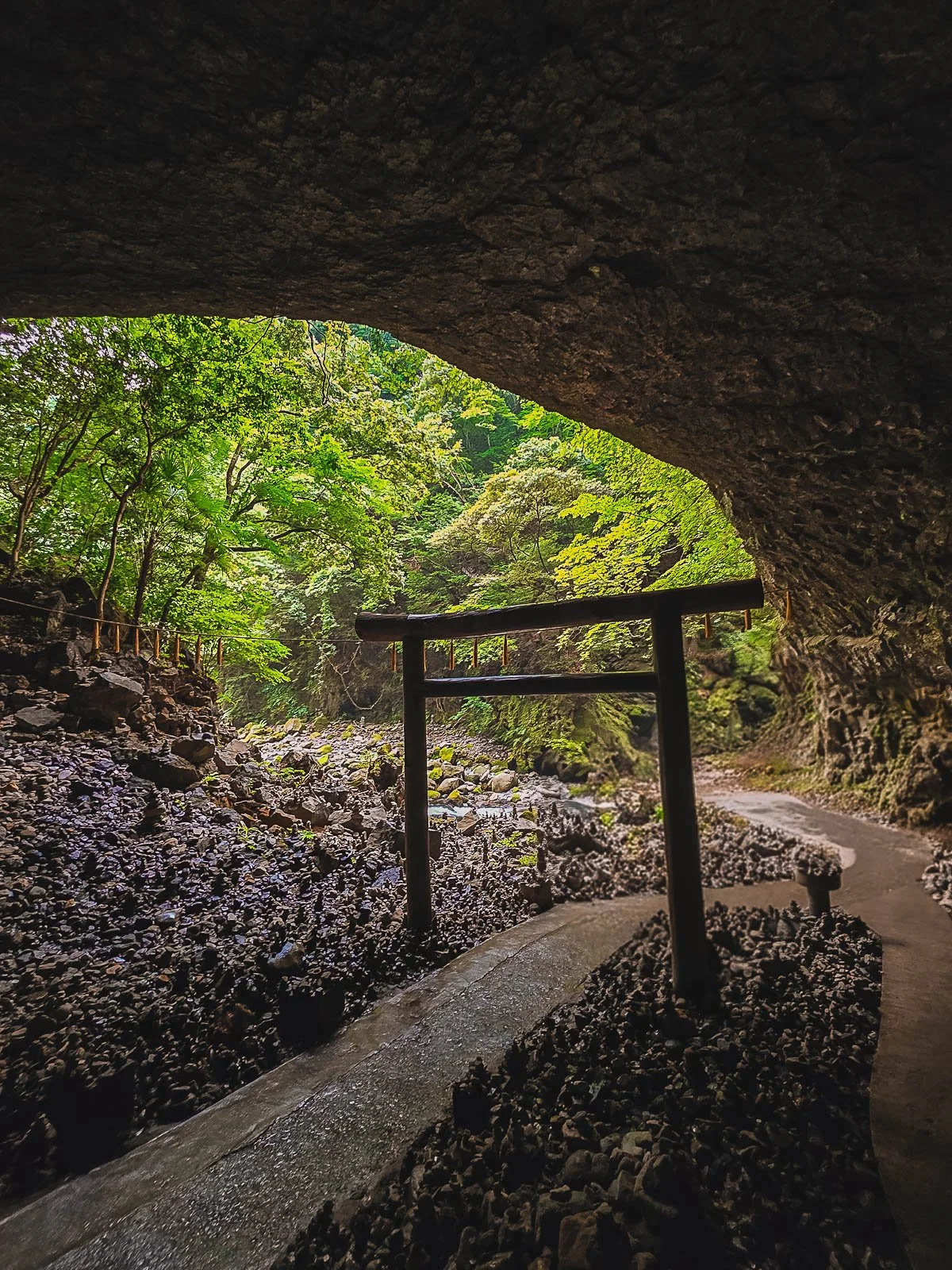
Afterwards we visited another beautiful and mysterious shrine: Amanoiwato Shrine which is inside a cave. We had to rush a bit as we were there about 1 hour before closing and it’s a bit of a walk from the car park down along the river and to the cave. But when it comes to unique shrines, Kyushu really does them well!
If you were in the Takachiho area for longer, I’d recommend doing the Amaterasu Railway scenic train ride. It’s something I really wanted to do but we unfortunately didn’t have time.
Amanoiwato Shrine
Day 12: Aso
Where we planned to stay: Fairfield by Marriott Kumamoto Aso
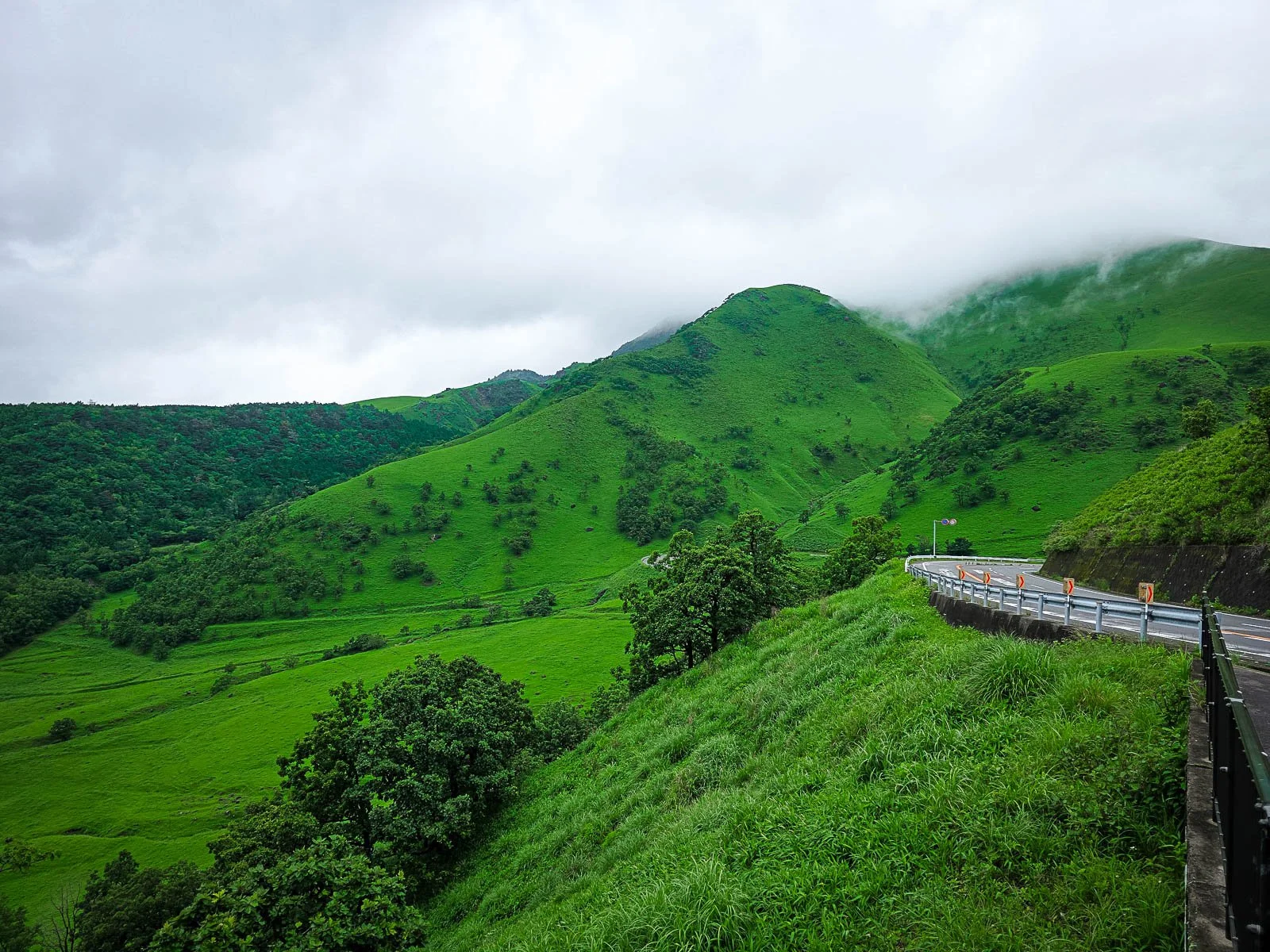
Aso Kuju
Another day where the weather unfortunately ruined our plans as visibility was too poor and terrain was too dangerous for hiking in Aso-Kuju National Park (we had a landslide warning on our phones!)
We had planned to stay overnight in Aso-Kuju National Park so we could get up early and see the volcano crater and do a short hike, but both were cancelled due to the weather so we decided to cancel our hotel and just spend the day in the area before heading on to Beppu and spending an extra night there.
So we settled with driving through the Aso-Kuju National Park and it is stunning, with lush green rolling hills and winding roads.
You can visit the Aso Nakadake Crater, an active volcano accessible by vehicle, or the Kusasenri Observatory to see the grassy plains and wild horses.
On our way toward Beppu, we stopped at Kamishikimi Kumanoimasu Shrine which again was a shrine that definitely lent itself to the misty, dark weather!
This Shinto shrine is tucked away in a cool, misty forest where you ascend hundreds of mossy stone steps lined with stone lanterns. It felt like a mystical place and again we had it almost all to ourselves, there were just 4 other people in the car park and on the steps through the forest we only saw two others!
It’s free to visit, there is free parking on the side of the road and public toilets halfway up the steps within the forest.
From the shrine it’s a 2 hour drive to Beppu.
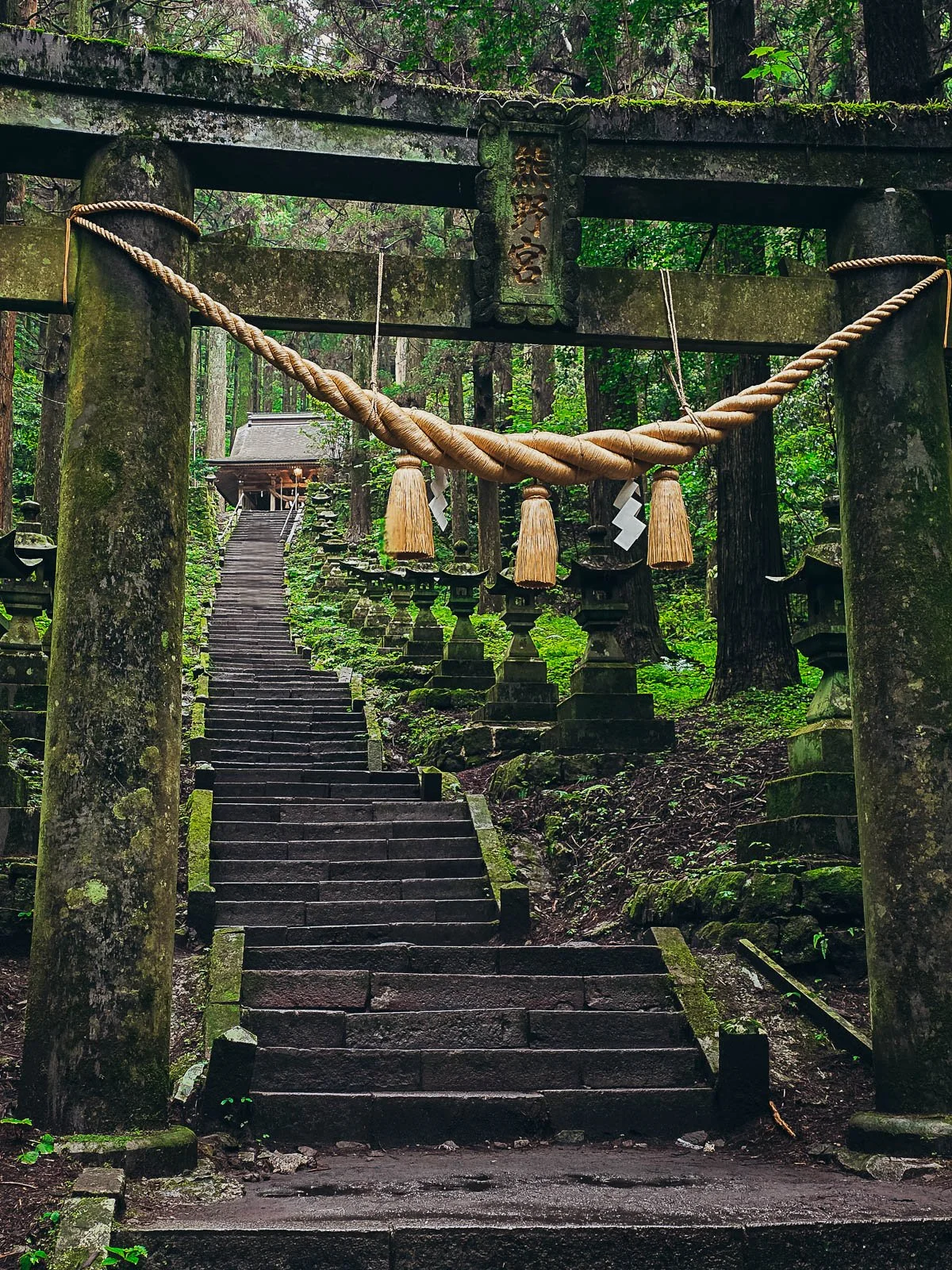
Kamishikimi Kumanoimasu Shrine
Day 13-14: Beppu
Where we stayed: AMANEK Beppu YULA-RE
Honestly I’m kind of glad the weather situation worked out how it did because Beppu exceeded all my expectations and we had such a great time here!
Read my detailed 2 days in Beppu guide.
This was definitely helped by the hotel we stayed in which we booked so last minute and ended up being possibly the best stay of our whole Kyushu itinerary!
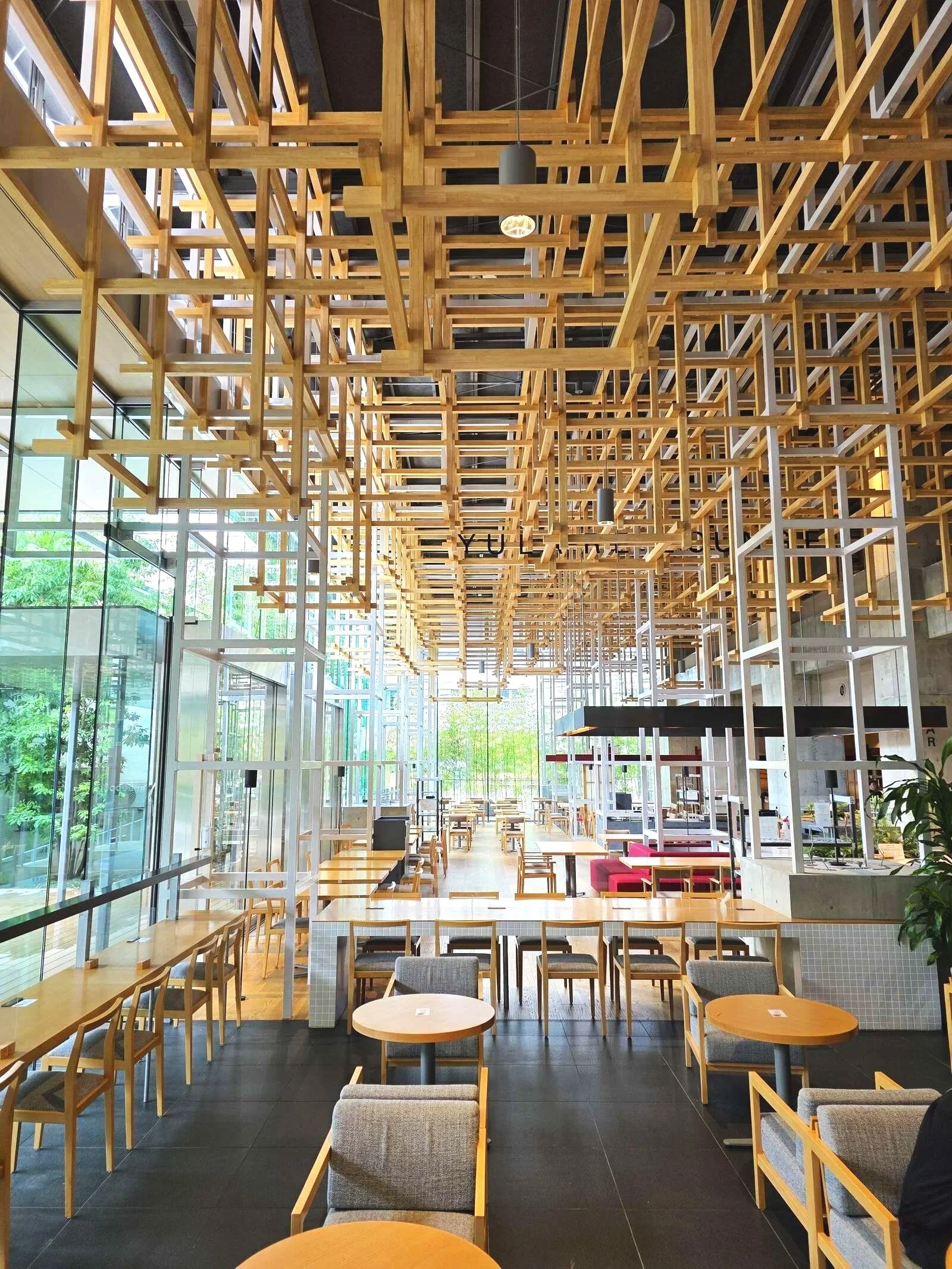
The lobby of our Beppu hotel
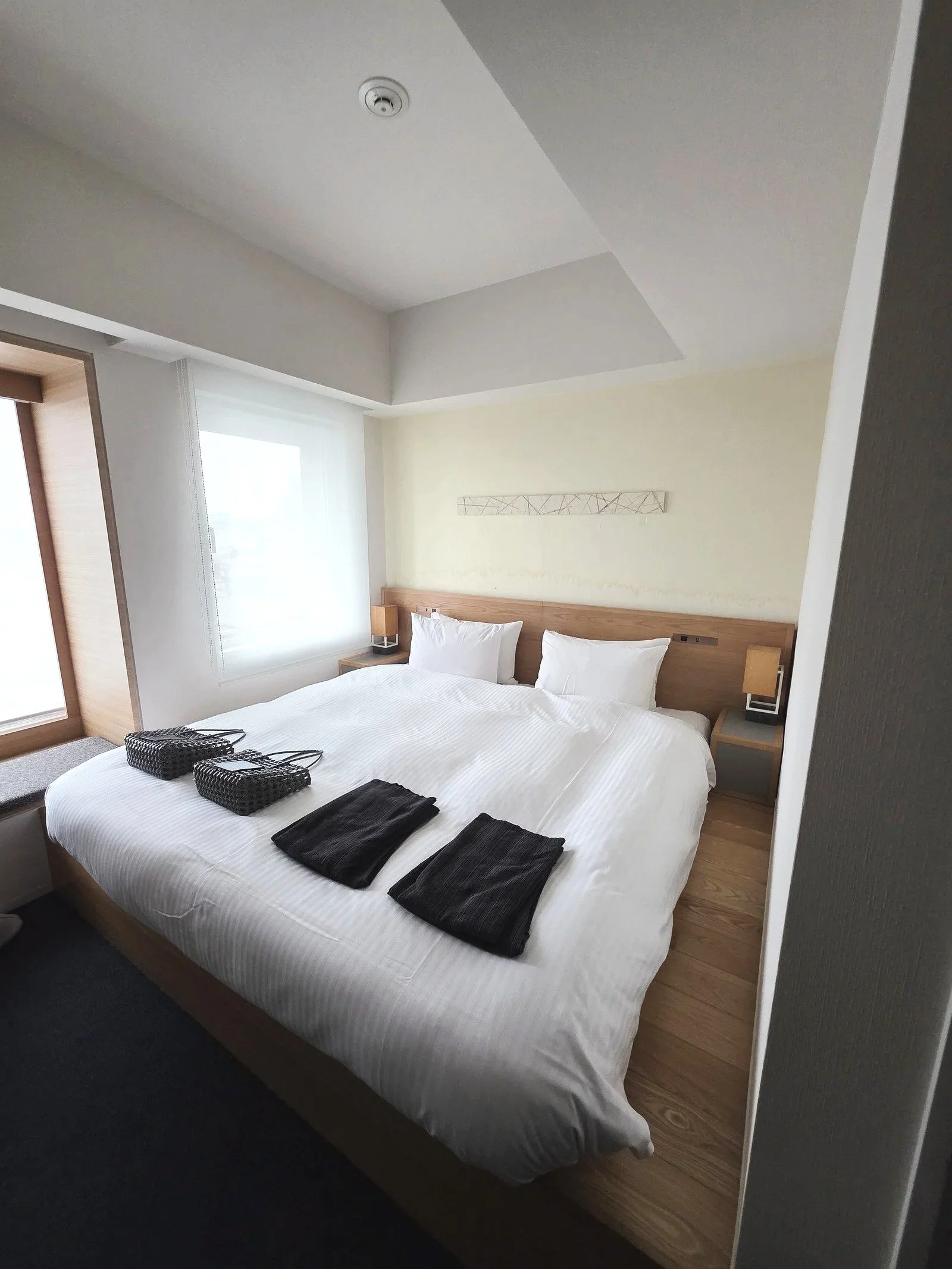
Amanek Beppu Hotel Room
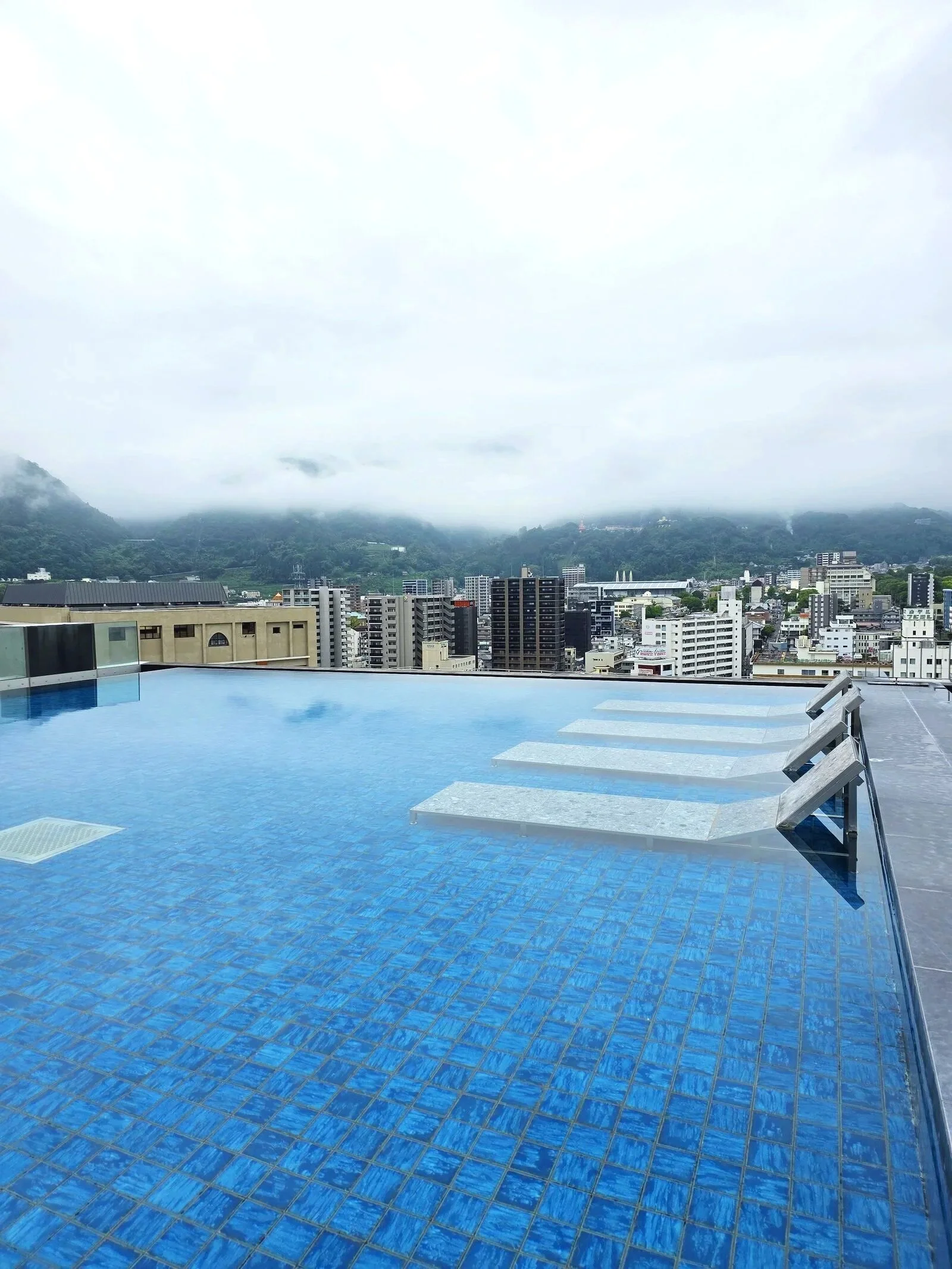
Our hotel rooftop pool in Beppu
Amanek Beppu Yula-re Hotel is perfectly located to be able to walk into central Beppu in the evenings, it had parking just across the road for our rental car. The hotel was stunning, modern and had open-air traditional onsens AND a rooftop heated pool and jacuzzi. The rooms were beautiful, modern and chic, the breakfast buffet was amazing and every evening they have Happy Hour which is basically an “all you can drink” for 1,000 yen. All this for only £62 per night!
After long days, lots of sights, lots of driving and lots of rain - this hotel was exactly what we needed!
Beppu is the largest hot spring town in Japan with more than 2,000 onsens. You will see steam rising from drains and houses all over the town. You can see this if you go up to the Yukemuri Observation Deck which gives you views of Beppu and the hundreds of plumes of steam rising from the town!
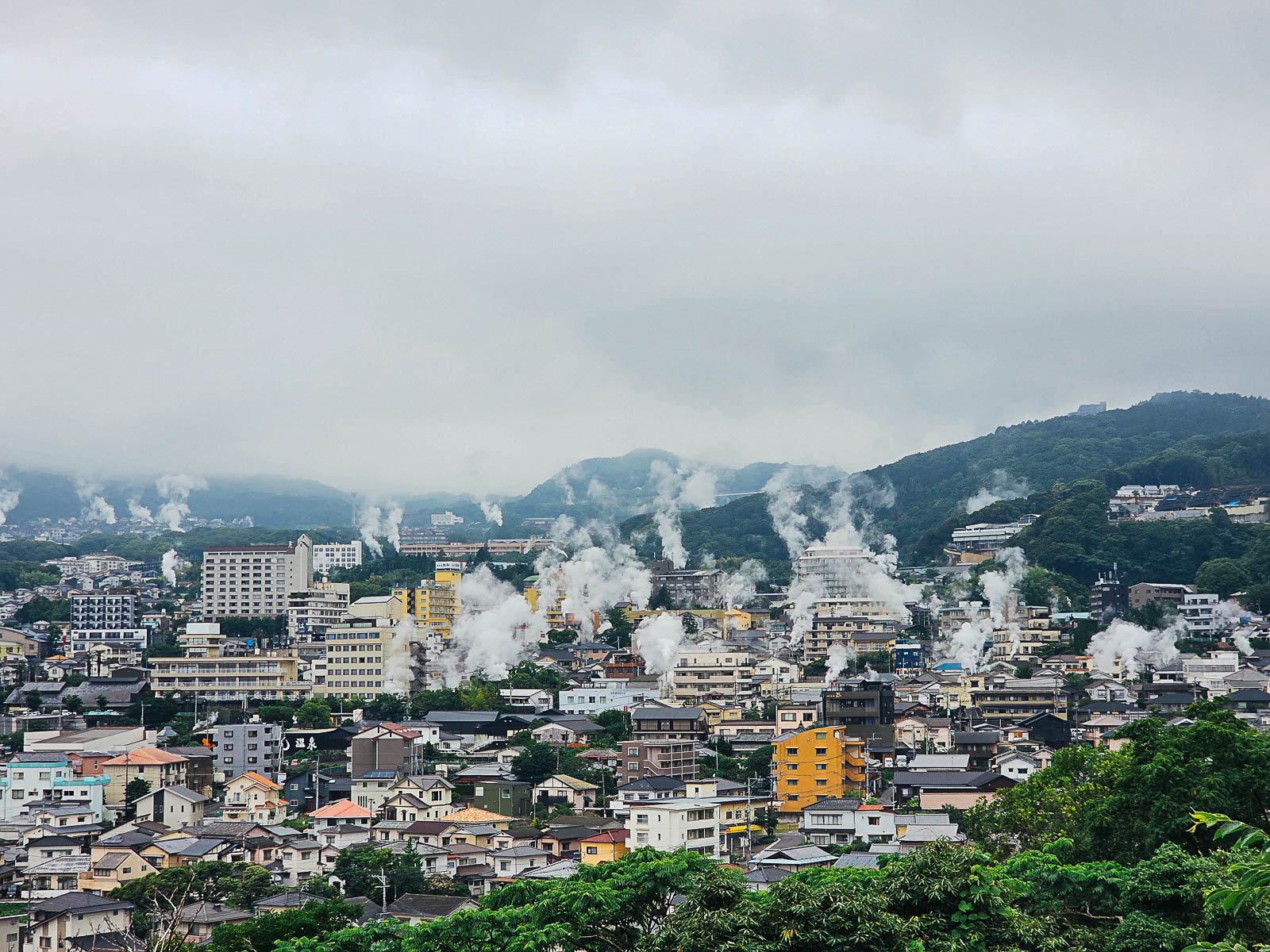
Beppu
Of course you have to visit the Hells of Beppu while you’re in Beppu. You’ll definitely need a car to see them all. There are 7 Hells in total, called “Jigoku”. These are very hot geothermal pools and none of them are suitable for swimming.
Umi Jigoku, Oniishi Bozu Jigoku, Kamado Jigoku, Oniyama Jigoku and Shiraike Jigoku are located at the main complex where you can go to buy tickets and there is free parking. You can walk between all five of them. Umi Jigoku is the most famous with bright blue, almost fluorescent water!
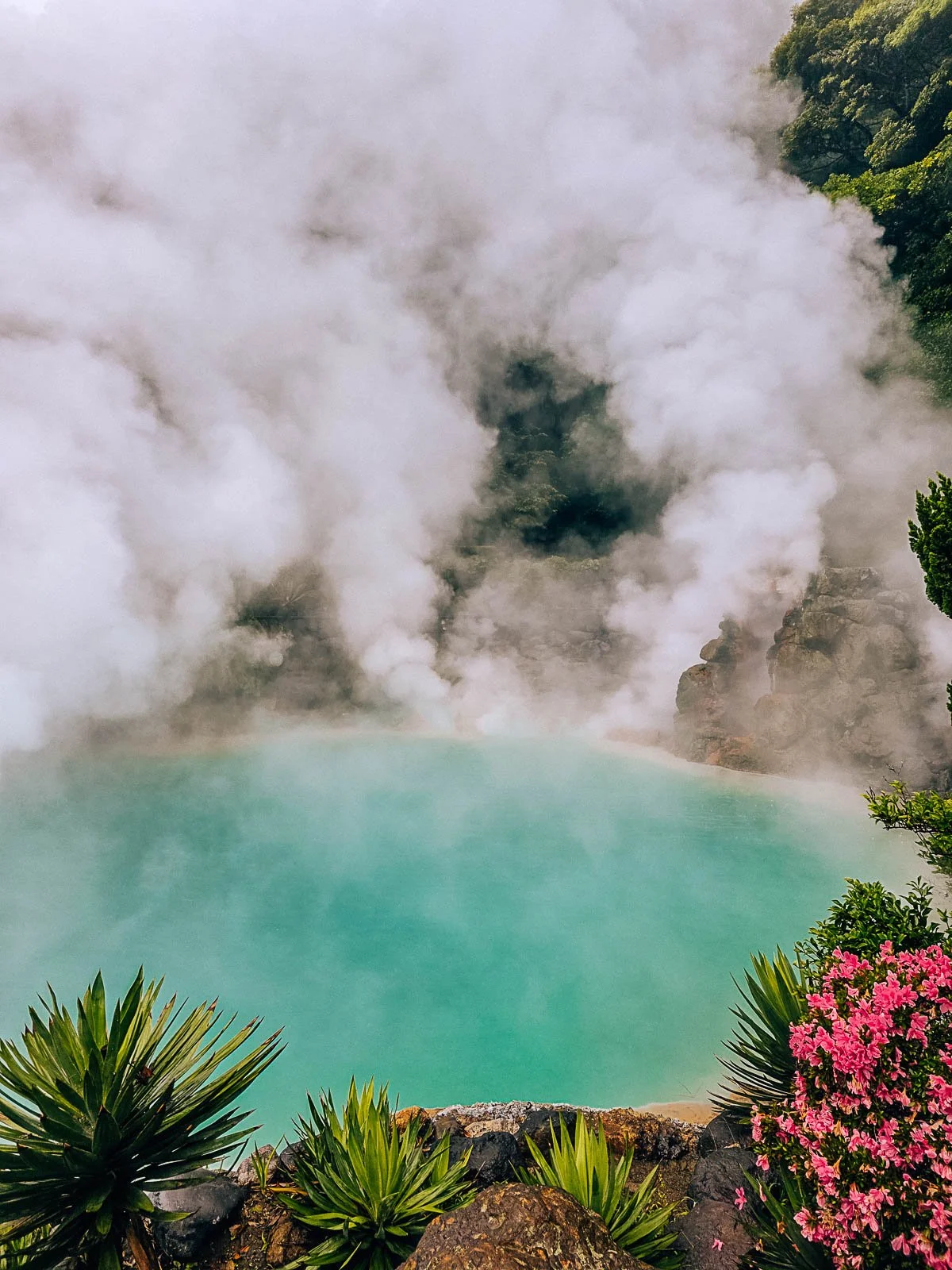
Beppu Hells
The other two are close together but located a further drive away so it’s up to you whether you buy a ticket to include these two or not. These are: Chinoike Jigoku (bright red pool) and Tatsumaki Jigoku which is a geyser that erupts every 30 minutes which is cool to see!
It’s only a 6 minute drive between the main complex and these two additional locations but it’s up a windy road that’s steep in some places so I’d recommend taking your car.
On your second day in Beppu, I highly recommend booking a room in a private day onsen. We booked at Sakura-yu which was incredible but there are dozens of places like this in Beppu to choose from!
At Sakura-yu, there are 16 rooms and you get to choose one. Prices vary depending on the size and style that you pick but we paid 3,000 yen for room 16 for 90 minutes. This is a traditional room with cobblestone bath and flooring and most rooms have a large doorway which you can open up to the trees outside - with complete privacy.
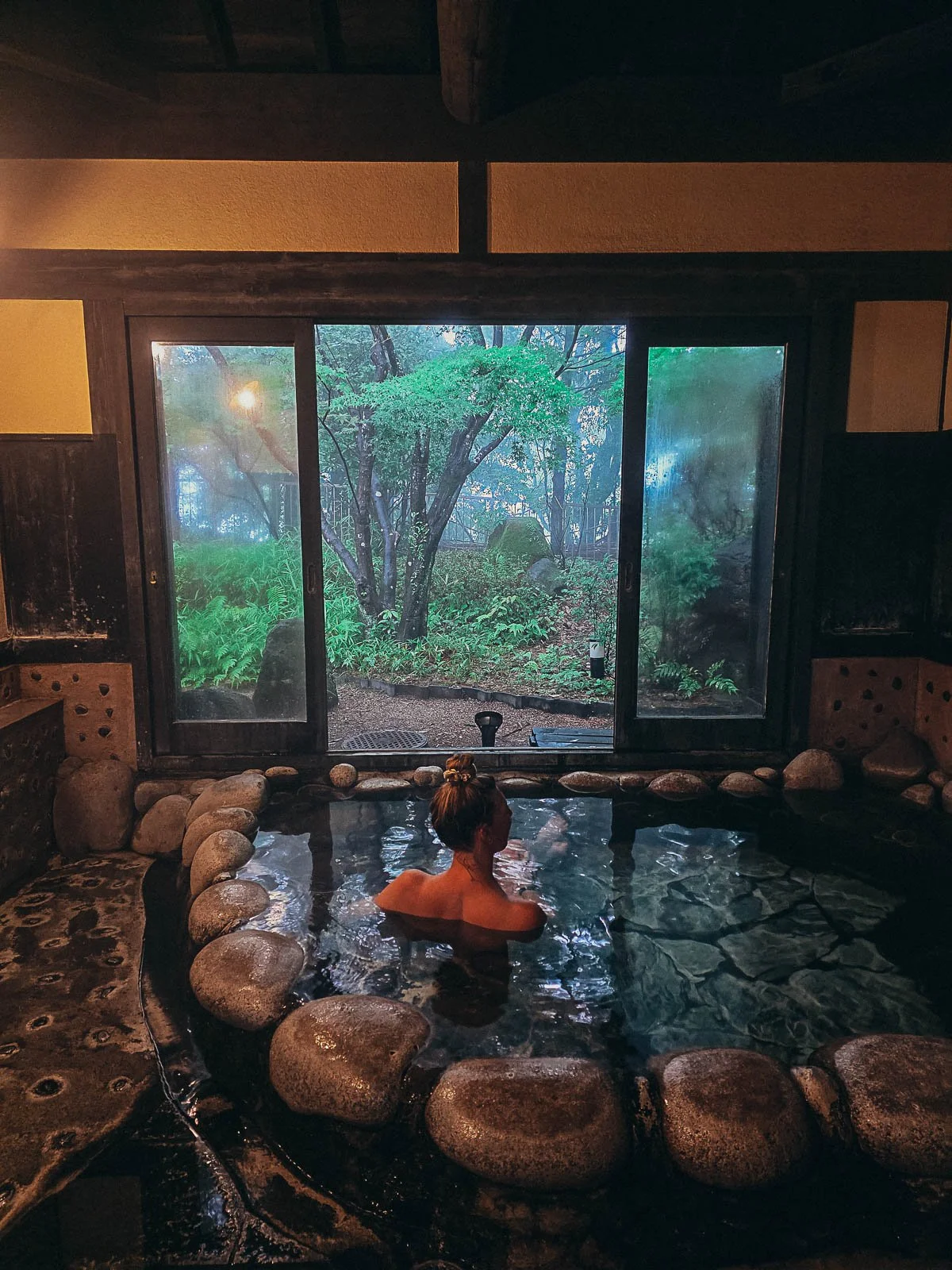
Beppu Private Onsen
Booking a private onsen is a great option if you perhaps want to go in an onsen with your opposite gender partner as most public onsens are separated by gender. The other bonus of a private onsen is if you have tattoos as many public onsens do not allow tattoos.
Sakura-yu wasn’t busy at all when we visited on a weekday in June, we could pick from almost any of their 20 onsen rooms and they have a shop and cafe onsite. Oh and their general manager is a cat named Kancho who you might see roaming around!
In the afternoon, explore Beppu, eat at a steamed restaurant where the food is cooked by steaming over the thermal springs in the town!
We also enjoyed Beppu Brewery and Mochigahama Seaside Park.
Day 15: drive back to Fukuoka via Yufuin
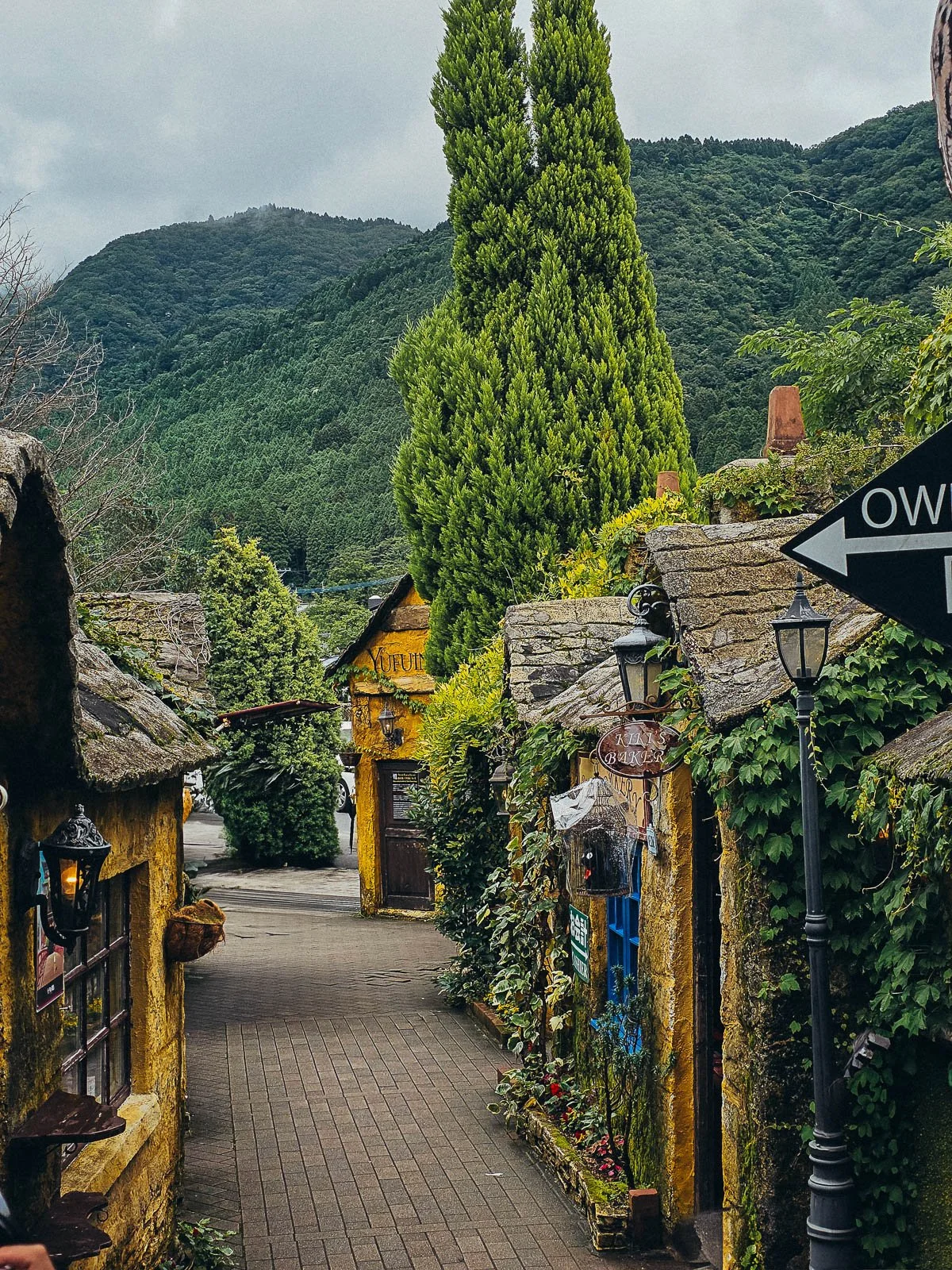
Yufuin Village
The drive from Beppu back to Fukuoka is only 2 hours so we broke up the day with a couple of stops along the way.
Our first stop was in the village of Yufuin which is another one of the famous places in Kyushu that people visit and that’s mostly due to it becoming social media famous.
It’s a small town that has a Ghibli-esque area called Yufuin Floral Village which is supposedly modelled on the Cotswolds in England. If you’ve been to the Cotswolds, it’s nothing like it in reality but it is a kitschy, fun area to explore however it gets VERY busy.
If you’re able to arrive before 10-11am before the tour buses from Fukuoka then that’s probably best. However there are other areas of the village like Lake Kinrin, Yunotsubo Shopping Street and even a public footbath at the train station which are less busy than the floral village.
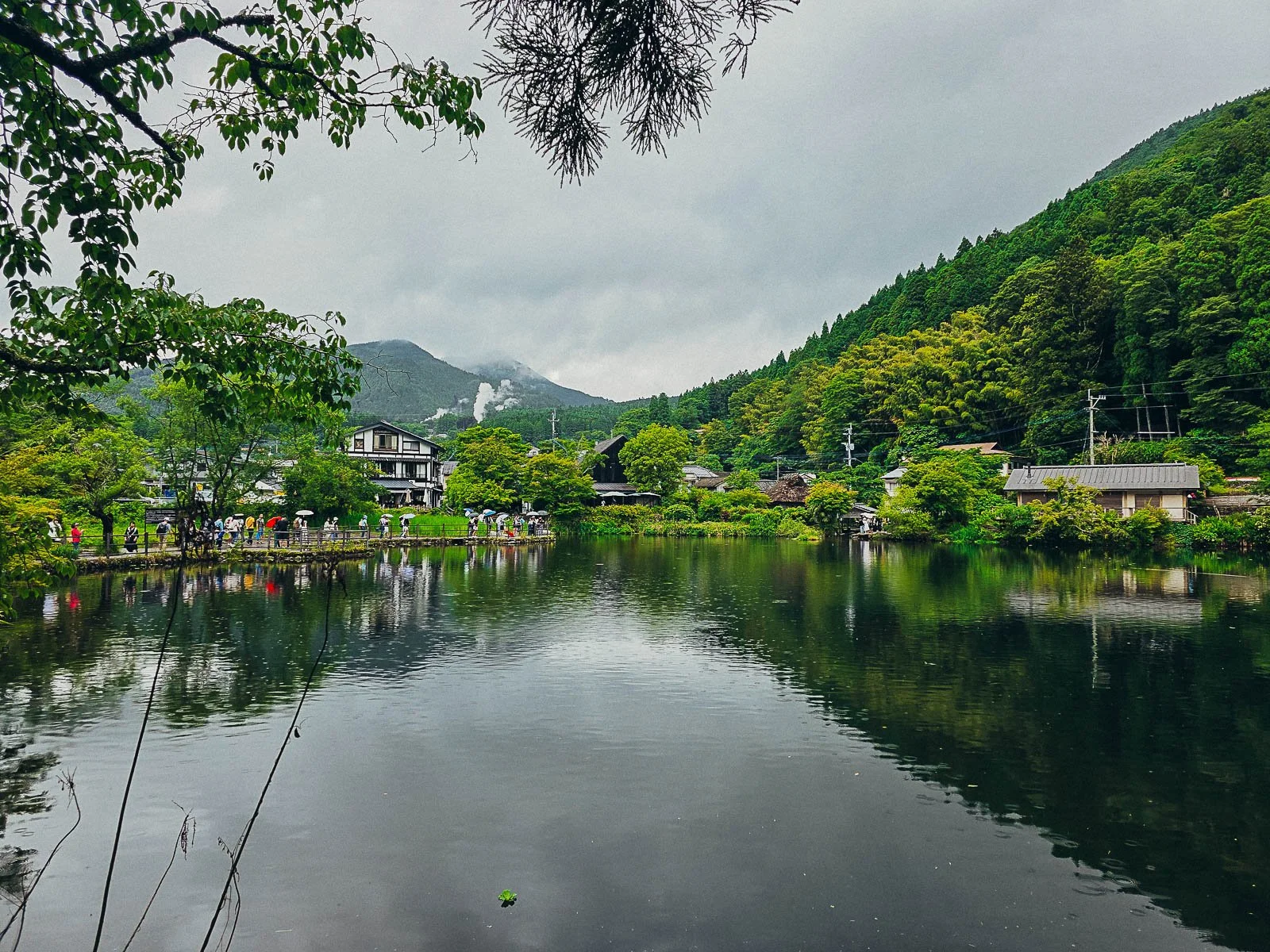
Kirin Lake
In total we only spent about 90 minutes in Yufuin before continuing on.
Our next stop was Sakuradaki Waterfall which was another surprising highlight! I chose to stop because I’d seen that it was easy to get to with just a short walk from the car park off the main road.
The car park is free and it’s a 5 minute walk along a paved path to get to the falls and they are gorgeous - again probably more so because of the recent heavy rain. But there was no one else around and we were able to walk right up to the falls!
Further along the drive, closer to Kurume, we also stopped at Ukiha Inari Shrine which has a long line of torii gates up the hill, similar to Kyoto’s Fushimi Inari, except there was no one there - we had it all to ourselves and with the hydrangeas flowering, it was such a beautiful spot.
From here it’s just over 1 hour back to Fukuoka for you to either spend one more night or return your rental car and head straight to the airport.
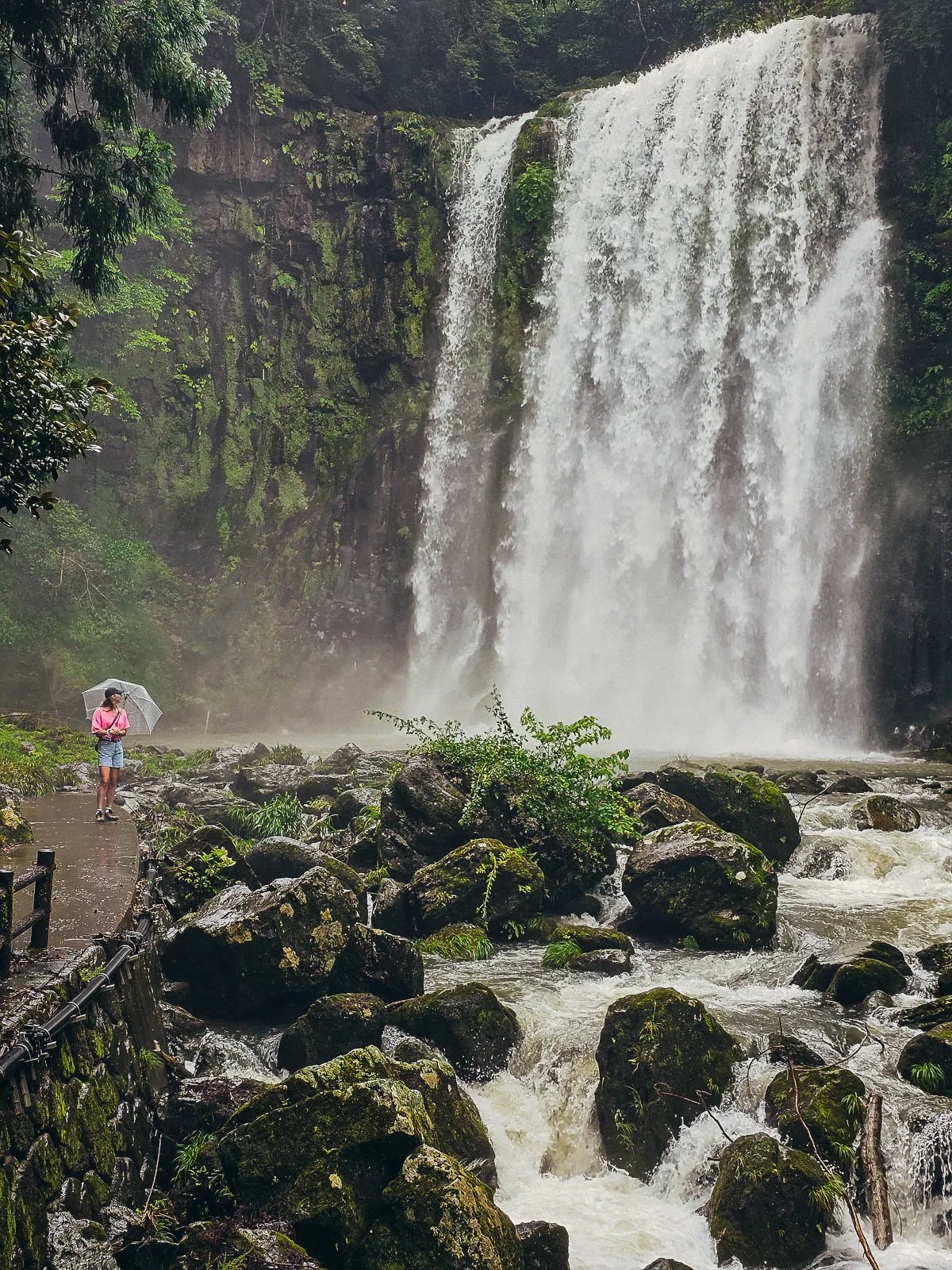
Sakuradaki Waterfall
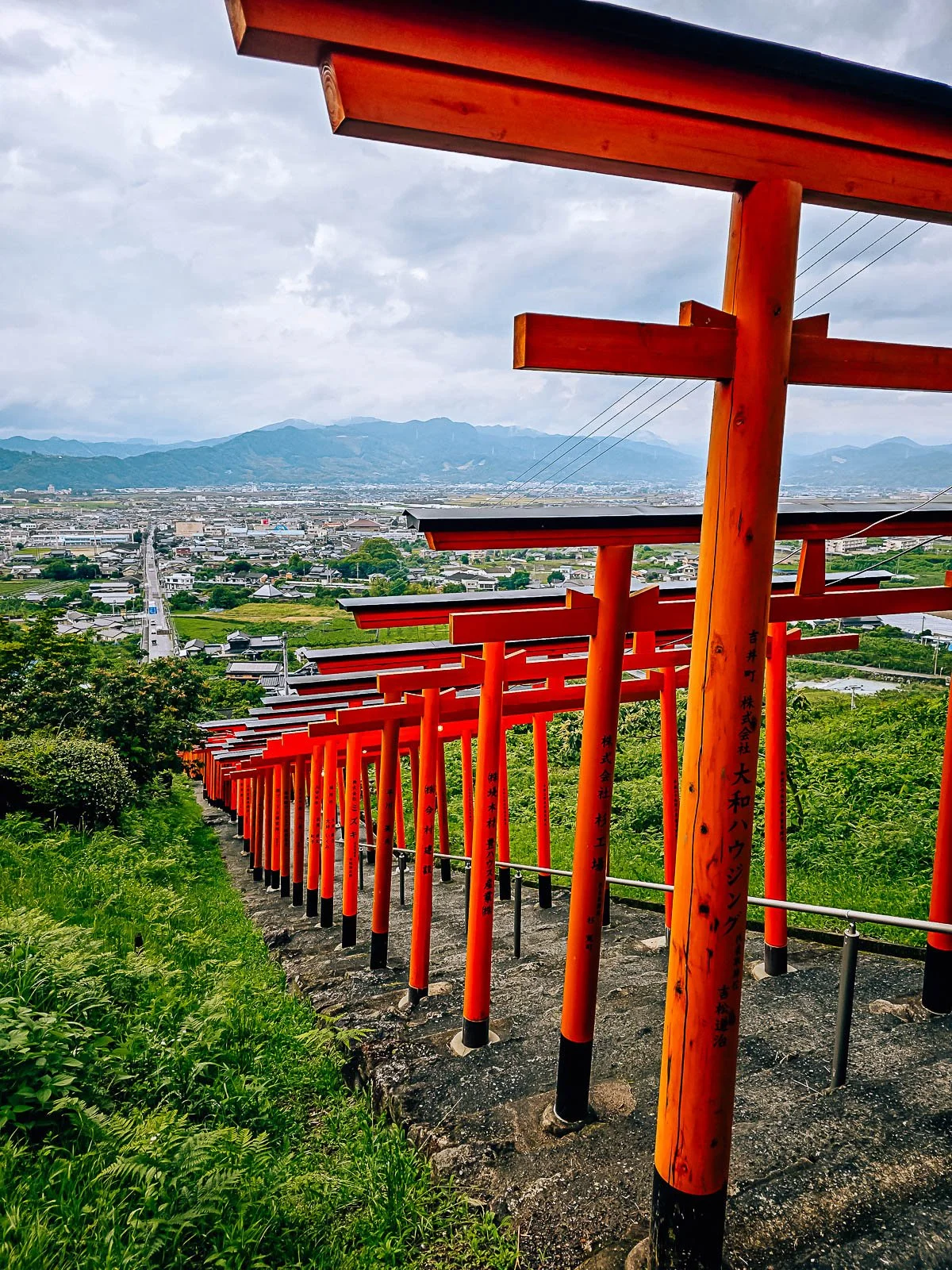
Ukiha Inari Shrine
Summary: Our Kyushu itinerary for 2 weeks
I hope this Kyushu Japan itinerary has helped you to plan your own route for your trip to Kyushu!
We really felt that a self drive Kyushu itinerary helped us to make our own plans and also be able to change them as needed - which turned out to be key for us and the amount of rainfall we had!
